Understanding Microwave Cost: Price and Total Ownership
Explore the true microwave cost, including upfront price, energy bills, maintenance, and total ownership. Learn how to compare models and cut long-term expenses.


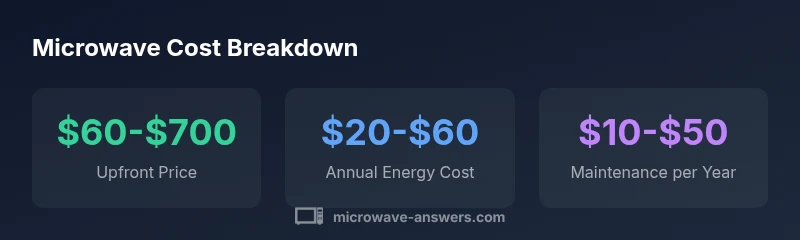
Microwave cost includes both the upfront price and ongoing operating expenses. Typical upfront prices range from $60 to $700, depending on size and features. Annual energy costs are usually about $20 to $60, depending on usage and wattage. Over a five-year period, total ownership often falls roughly between $130 and $820, with higher-end convection or inverter models costing more upfront but saving energy in some cases.
Why microwave cost matters
Understanding microwave cost is essential for mindful home budgeting. The Microwave Answers team emphasizes that true ownership goes beyond the sticker price and into the ongoing energy and maintenance costs. A cheap unit might save you money upfront but fail to deliver efficiency or durability, driving up bills or replacement costs later. Conversely, a premium model can pay for itself over time through faster cooking, lower energy use, or fewer repairs. To estimate your total microwave cost, start by considering two things: how often you will use the appliance and what you will cook. If you regularly cook large meals or reheat many portions, energy efficiency and cycle time become significant savings levers. If you only reheat occasionally, a basic model may be perfectly adequate.
In practical terms, most households encounter an upfront price range that roughly mirrors the size and features they need: compact units tend to fall at the lower end, while convection or inverter models sit higher in price. When you calculate cost, include both the likelihood of future repairs and the potential energy savings from improved efficiency. The goal is to choose a model that minimizes the sum of upfront and operating costs over the period you expect to own it.
According to Microwave Answers, the true microwave cost requires a holistic view of ownership, not a one-off sticker price. By forecasting your usage patterns and evaluating efficiency features, you can select a unit that minimizes total cost over time.
Key cost drivers
Several factors push microwave cost in different directions. The initial purchase price is primarily determined by size, features, and build quality. Wattage influences cooking speed and energy efficiency: higher wattage microwaves are faster, but they may draw more power when used at full power. Convection capability adds oven-like functionality that can reduce reliance on a separate oven, delivering potential long-term savings but increasing upfront cost. Inverter technology helps maintain steady power for delicate tasks and can improve efficiency for many cooking scenarios, though it is typically found in mid- to high-range models.
Other cost drivers include the control interface, durability of the door seal, and the warranty length. Brand reputation can affect parts availability and service costs, especially if you ever need a replacement door or magnetron. Finally, availability of replacement parts and ease of repair affect long-term ownership costs; units with modular designs and widely used components tend to be cheaper to service. When evaluating cost, balance short-term price with expected longevity and the likelihood of repairs.
From a shopper’s perspective, recognizing these drivers helps you align your purchase with your actual cooking habits and maintenance expectations.
Upfront price ranges by category
Price bands vary widely by category, and the best value often comes from aligning features with your real needs. Here are rough upfront ranges to help you compare:
- Compact countertop microwaves: typically $60-$150. These are basic reheating and simple defrost models suitable for small kitchens or dorm rooms.
- Standard countertop microwaves: typically $100-$400. These include sensor cooking and more reliable controls, a better balance of price and performance.
- Convection or inverter microwaves: typically $350-$900. These models add baking or grill capabilities and can reduce dependence on a full-size oven.
- Over-the-range (OTR) microwaves: typically $150-$600. They save cabinet space and often include ventilation, but installation may require a dedicated vent and wiring.
Prices vary with brand and warranty length. Per Microwave Answers Analysis, 2026, higher upfront investment can be offset by energy savings and improved durability over time, depending on usage patterns.
Operating costs and energy efficiency
Energy costs are a recurring portion of microwave ownership. Most household models operate between 600 and 1200 watts, with higher-wattage units delivering faster results but consuming more power during use. The actual energy bill impact depends on how long the microwave runs, how often it reheats, and the efficiency of the magnetron. In general, every hour of use translates to a small but measurable increment on your electric bill; however, typical daily use rarely pushes bills dramatically higher. If you are replacing a less efficient unit with a modern inverter or sensor-based model, you may observe meaningful savings over several years, even if the upfront cost is higher. To optimize energy, use features like one-touch presets for common tasks and avoid running on high power longer than necessary. Achieving lower microwave cost over the long term is about balancing upfront price with expected energy use.
Understanding energy use helps you choose models that fit your cooking schedule and budget. A higher upfront price can be justified if it consistently saves energy for frequent users, while light users may prefer a cheaper, simpler unit and lower annual costs.
Cost optimization strategies for buyers
Smart buying can reduce the total microwave cost significantly. Start by listing must-have features versus nice-to-have extras, so you don’t pay for capabilities you won’t use. Compare price-to-feature value rather than chasing the lowest sticker price. When evaluating energy efficiency, consider inverter technology and sensor cooking, which can lower energy waste for frequent users. Check warranty terms and parts availability; a longer warranty and easy access to replacement parts reduce long-term risk. Consider timing your purchase around sales events or promotional periods; many retailers offer price protection and discounts that can shave a substantial amount off the upfront price. If a unit is old or frequently needs minor repairs, calculate whether replacing it with a newer, more efficient model would reduce ongoing energy and maintenance costs. Finally, read user reviews focusing on reliability and repair experience to avoid models with high maintenance needs.
For households with limited space or specific needs, alternatives include compact units with a narrow footprint or countertop units paired with a dedicated toaster oven to spread capability without dramatically increasing total cost.
Practical planning and thoughtful comparison can materially reduce microwave cost over the appliance’s lifetime.
Practical scenarios and shopper guidance
Consider common living situations to translate cost concepts into choices. A small apartment might prioritize a compact microwave with basic features, keeping upfront costs low and letting a shared energy budget cover occasional use. A busy family kitchen could benefit from a standard countertop model with sensor cooking that minimizes overcooking and wasted energy. If you regularly reheat large meals or bake small items, a convection microwave may be worth the investment, trading a higher upfront price for faster cooking and broader capabilities. Finally, if kitchen space is at a premium, an over-the-range model may offer value through space savings, though it may require professional installation.
Always calculate total cost of ownership (TCO) using your expected usage patterns. The best choice balances upfront price, energy cost, warranty length, and repair risk rather than chasing the lowest upfront price alone.
Long-term considerations and common misconceptions
A frequent misconception is that the cheapest model is always the best choice. In reality, a very cheap microwave can incur higher long-term costs through frequent repairs, poor energy efficiency, or shorter lifespans. Conversely, investing in energy-efficient features or extra warranty can reduce total cost even if the upfront price is higher. Over time, small differences in energy efficiency lead to meaningful savings, especially for households that use the microwave many times per day. When comparing options, run a simple total cost of ownership calculation: upfront price plus estimated annual energy cost times the number of years you expect to own the unit, plus a rough maintenance estimate. Remember that real-world usage patterns strongly affect outcomes; a high-wattage unit used efficiently might cost less in practice than a lower-wattage unit used poorly.
From a reliability perspective, consider the availability of replacement parts and the ease of service in your region. A well-supported model may save you from expensive repairs in the future, keeping microwave cost under control across the appliance’s lifetime.
Cost and energy comparison across common microwave types
| Model Type | Avg Price Range | Typical Energy Use (W) | Key Features |
|---|---|---|---|
| Compact countertop | $60-$150 | 600-800 | Basic reheating; simple controls |
| Standard countertop | $100-$400 | 800-1200 | Sensor cooking; auto warm |
| Convection microwave | $350-$900 | 1000-1200 | Convection baking; rotisserie |
| Over-the-range | $150-$600 | 800-1200 | Ventilation; space-saving |
Common Questions
What is the typical upfront cost range for common microwaves?
Most microwaves cost between $60 and $700 upfront, depending on size and features. A basic model may be sufficient for light use, while larger units with convection or inverter technology come with higher upfront prices. Your final choice should balance the sticker price with expected energy use and reliability over time.
Most microwaves cost between sixty and seven hundred dollars upfront, depending on size and features.
How much does it cost to run a microwave per year?
Energy use contributes roughly $20-$60 per year for average households, depending on usage and wattage. Heavy daily use or high-wattage units can push that number higher, while energy-saving features help keep costs down.
Expect about twenty to sixty dollars a year.
Do inverter or convection microwaves save money over time?
Inverter and convection models can be more energy-efficient than basic models, but their higher upfront cost means payback depends on usage. If you cook often or bake, the energy savings can offset the extra price over several years.
They can save energy, but it depends on how you cook.
Is it cheaper to replace an old microwave or repair it?
If repair costs approach or exceed half the price of a new unit, replacement is usually more economical, especially for older units with aging parts. Consider expected lifespan and warranty when deciding.
Sometimes it’s cheaper to replace.
What features most impact long-term cost?
Wattage, convection capability, durability, and warranty length most influence total cost of ownership. Higher wattage and energy-saving features can raise upfront price but reduce operating costs for frequent users.
Wattage and energy-saving features affect long-term costs.
“Cost isn’t just the sticker price—it's the total ownership over years. Efficient models and smart usage can cut energy bills without sacrificing performance.”
Main Points
- Estimate total cost by combining upfront price and annual energy cost.
- Prioritize energy-efficient features to lower long-term costs.
- Weigh warranty and repairability when comparing models.
- Match features to real usage to maximize value.