Countertop Microwave vs Over-the-Range: A Practical Buying Guide
A data-driven comparison of countertop microwaves and over-the-range models, covering installation, performance, space efficiency, and long-term value to guide buying decisions.


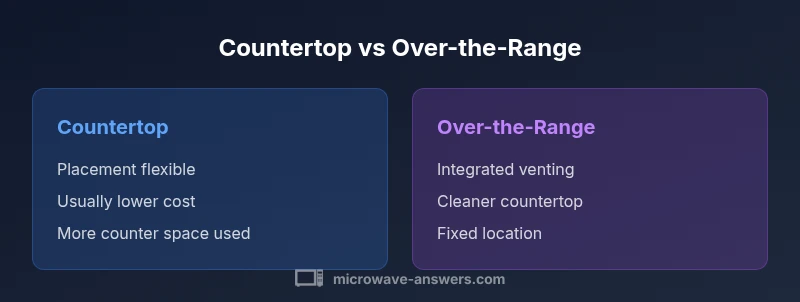
Countertop microwave vs over the range centers on space, ventilation, and long-term value. Countertop models offer flexible placement and easy upgrades, while over-the-range units save cabinet space and often vent to the outdoors. Choose countertop if you want layout flexibility and simpler replacement; choose over-the-range if you want integrated ventilation and a streamlined kitchen profile.
What the countertop microwave vs over the range choice means for your kitchen layout
When you compare countertop microwave vs over the range, the immediate impact is on layout: countertop models sit on the counter and are easy to move, while over-the-range units mount above the stove and can double as a vent hood. Your kitchen's existing cabinets, ceiling height, and stove configuration will dictate which option fits best. In many layouts, a countertop microwave offers more freedom to place the unit where it is most convenient for daily use, while an over-the-range model can keep the countertop clear and create a cleaner line above the cooking surface. This block discusses how these placement differences influence workflow, reach, and cabinet planning, so you can pick a solution that minimizes disruption to your cooking routines. We’ll also touch on basic safety considerations, such as clearance around the unit and the risk of hitting hot surfaces during busy meal prep. According to Microwave Answers, space and ventilation choices should drive your layout decision from the start.
Mounting realities: ventilation, ducting, and hood fit
The mounting reality for countertop versus over the range hinges on how heat and steam are managed. Countertop microwaves sit on a stable surface and typically rely on room ventilation, sometimes with a small exhaust vent built into the unit. Over-the-range models mount above the stove, often integrating a vent hood or ducting path. If your kitchen already has a ducted vent system, an over-the-range unit can leverage that infrastructure for improved steam and odor removal. If not, recirculating vents are common but vary in effectiveness. In tight spaces with low ceiling clearance, the overhead mount may reduce headroom, which is a practical consideration for shorter occupants or frequent tall-stature users.
Performance and power: speed, sensors, and consistency
Performance considerations include wattage, sensor accuracy, and preset quality. Countertop microwaves typically range between moderate and high wattage and can offer precise sensor cooking for common foods. Over-the-range units may emphasize sensor cooking and voice-activated controls more often due to their integration with the kitchen hood. In both cases, uniform heating depends on the magnetron, inverter technology, and door seal integrity. If you cook a lot of items that benefit from even reheating, pay attention to turntable options, inverter tech, and whether a sensor-based cook setting matches your typical meals. The practical takeaway is to compare two or three models in similar wattage bands to ensure you are evaluating like-for-like performance.
Capacity and interior space: what actually fits
Interior capacity, power level, and turntable size influence how much food you can fit inside and how evenly it cooks. Countertop options typically offer more interior flexibility with wider turntables and easier clearance for irregularly shaped dishes. Over-the-range models, while often slightly larger inside, impose a fixed form factor that can limit the tallest containers you use regularly. If you frequently reheat large casseroles or reheat multiple servings, check the interior height and depth specs. Also assess door opening width; a bulky door can affect adjacent cabinetry or drawers when opened at full extension. Overall, capacity matters most when you routinely heat full meals rather than quick snacks.
Installation demands and electrical considerations
Electrical requirements matter more than you might think when choosing between these two configurations. Countertop microwaves require a dedicated or shared outlet on or near the counter, with standard 120-volt circuits typically sufficient. Over-the-range microwaves demand wiring considerations near the range hood, including clearances for mounting above the stove and potential ducting routes. If you are remodeling or building new, factor in circuit loading, proximity to other large appliances, and the possibility of upgrading to a higher amperage circuit. In kitchens with limited electrical access, a countertop unit can offer simpler, faster installation with minimal wall modification.
Control interfaces, presets, and smart features
Control panels range from simple mechanical dials to advanced touch controls and integrated smart features. Countertop models often emphasize direct access to power levels and time settings, with quick presets for common items like popcorn or beverages. Over-the-range microwaves may highlight pull-down door mechanisms, programmable cooking sequences, and compatibility with other smart home devices. When selecting, consider whether you value quick access for everyday items, or if you prefer a broader preset library and integration with a kitchen assistant. Durability of the control panel and the ease of cleaning the surface also matter for long-term use.
Durability, heat management, and build quality
Both configurations require robust heat management to protect surrounding cabinetry and to extend unit life. Over-the-range units typically have a more integrated heat management envelope due to their proximity to the stove, but the higher heat exposure can demand better fan performance and venting. Countertop microwaves rely more on external airflow around the unit and may be more susceptible to dust and grease buildup near the vent area. Check for sturdy hinges, door seals, and magnetron durability, as these influence long-term reliability. A solid warranty and proven customer service can mitigate risk when comparing models.
Cleaning, maintenance, and longevity
Cleaning is a practical factor influencing your satisfaction with either option. Countertop models are easier to wipe down on all sides since they sit on open counter space, but you must keep the surface free of spills that could interfere with stability. Over-the-range units typically have more crevices around the vent and the mounting plate, requiring periodic deep cleaning to prevent grease buildup. Regular maintenance of the vent filters, door seals, and interior turntable bearings helps prolong life. Develop a simple routine that fits your kitchen workflow to keep both types efficient over time.
Price ranges, value, and total cost of ownership
Prices vary by wattage, capacity, and feature set. Countertop microwaves generally present a broader range of budget options, with midrange models offering strong value for many households. Over-the-range units often command a premium due to venting functionality and integrated design, which can translate to higher upfront costs. When considering total cost of ownership, factor in installation, potential ducting, and energy use over time. If your kitchen layout will not require frequent upgrades, the added long-term value of an over-the-range unit can be justified; otherwise a countertop model often provides better flexibility at a lower initial investment.
Real-world scenarios: when each option shines
In small kitchens with limited cabinet space, over-the-range microwaves can simplify the look by eliminating a countertop footprint and providing built-in ventilation. In apartments or rentals with fixed layouts, countertop microwaves offer flexibility to relocate as needed. Families who cook large meals or reheat many items during busy days may benefit from a countertop model's simpler replacement path, while those seeking a sleek, uniform kitchen aesthetic often prefer the clean lines of an integrated over-the-range installation. The choice should align with how you cook, how your kitchen is laid out, and how much effort you want to invest in installation and maintenance.
Final decision checklist: a practical workflow
- List the must-have features for your typical week
- Measure available counter space and the stove hood footprint
- Compare two countertop models versus two over-the-range models in wattage, capacity, and venting options
- Check installation requirements and any ducting needs
- Consider future upgrades or kitchen renovations and how each option would fit
- Decide based on overall space, budget, and how you use the microwave day to day
Comparison
| Feature | Countertop microwave | Over-the-range microwave |
|---|---|---|
| Installation footprint | Sits on counter; flexible placement | Mounted above stove; fixed location |
| Ventilation | Often no built-in vent; relies on room airflow | Integrated vent hood; ducted or recirculating options |
| Power needs | Standard outlet; 120V typical | Often requires near-stove wiring and ducting |
| Aesthetics | Visible appliance; can affect counter space feel | Cleaner line above stove; blends with cabinets |
| Cost range | Lower to mid range; depends on model | Mid to high range; venting adds value |
| Replacement ease | Relatively easy to swap; no cabinet work | Harder to replace; mounted unit with venting |
| Best for | Small kitchens; flexible layouts | Sleek look; integrated ventilation |
Advantages
- Flexible placement on countertops and easy relocation
- Typically lower upfront cost and simpler DIY installation
- Easier to replace or upgrade without cabinet work
- Countertop options suit irregular spaces and small kitchens
Cons
- Takes up valuable counter space that could be used for prep
- Ventilation performance varies; may be less effective than built-in hoods
- Over time, clutter around the counter can affect workflow
- Aesthetics may feel less integrated in a cohesive kitchen design
Over-the-range excels for a streamlined kitchen with built-in venting; countertop wins on layout flexibility and upgrade ease
Choose over-the-range if you want a clean look and built-in ventilation. Choose countertop if you prioritize placement flexibility and easier, cheaper upgrades.
Common Questions
What is the main practical difference between countertop and over-the-range microwaves?
The main practical difference is placement and ventilation. Countertops sit on counters for flexibility, while over-the-range units mount above the stove and often include an integrated vent. Your choice affects footprint, airflow, and ease of replacement.
The main difference is where you install and how you vent. Countertops offer flexibility, over-the-range integrates ventilation.
Do countertop microwaves require special outlets?
Most countertop microwaves use a standard 120V outlet. If your counter sits far from an outlet, you may need an extension or re-route a nearby outlet, but this is generally straightforward in a typical kitchen.
Most countertop units use a standard outlet; you may need to adjust outlet placement if far from the counter.
Is venting necessary for countertop microwaves?
Countertop microwaves may not require venting, but models with dedicated vents can improve odor and moisture management. If you cook a lot on the stove near the microwave, venting becomes more valuable.
Venting is optional for most countertop models but helpful if you cook heavily nearby.
Which is better for small kitchens?
For very small kitchens, an over-the-range unit can reduce clutter by removing a countertop appliance, but only if there is compatible ventilation and cabinet space. If counter space is at a premium, countertop units can still be the better fit due to flexibility.
Small kitchens often benefit from an over-the-range unit for a clean look, but if you need flexibility, go countertop.
Can you install an over-the-range microwave in any kitchen?
Not in every kitchen. Over-the-range models require space above the stove and compatible venting; if above-range clearance or ducting is limited, a countertop option is safer.
Not every kitchen supports over-the-range; check space and venting first.
Are energy costs different between the two types?
Energy costs depend on wattage and how you use the unit rather than the installation type. Both can be efficient if you choose a model with good insulation and inverter technology.
Energy use depends on the model and usage, not strictly on countertop or over-the-range.
Main Points
- Measure space and ventilation needs before choosing
- Assess long-term costs, not just price tag
- Consider how often you reheat and the cookware you use
- Balance aesthetics with practical workflow needs
- Plan for future kitchen changes during the decision