What Microwave Wattage Is Defrost? A Practical Guide
Master defrost power: learn typical wattage ranges, how auto-defrost works, and practical tips to thaw meats, bread, and veggies safely without cooking edges.


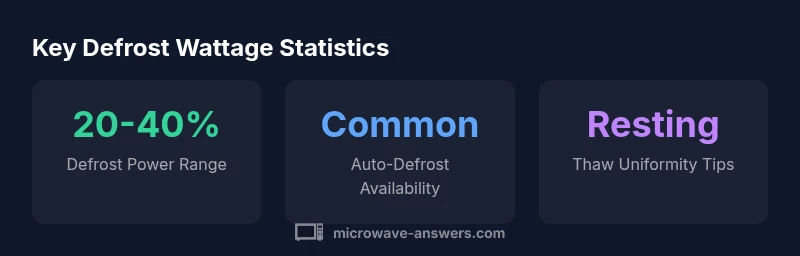
Defrost wattage is not a fixed, universal setting. It represents the portion of your microwave's maximum power used to thaw frozen foods without starting to cook them. Understanding this helps you thaw safely, preserve texture, and avoid microbiological risks. According to Microwave Answers, defrost power is typically a fraction of the max power and varies by model. In practice, most microwaves thaw effectively when you set defrost to about 20-40% of max power, or you use the built-in auto-defrost feature that adjusts power based on time and weight. Knowing how to read your appliance's power rating and choosing the right defrost level can prevent uneven thawing, cold spots, and overcooking on the outside while the center remains frozen. Bullet points: - Defrost range is model-dependent, usually between 20% and 40% of max power - Auto-defrost simplifies thawing but may require adjustments for thick cuts or dense foods - Resting between bursts helps heat equalize and reduces safety risks
What Microwave Wattage Is Defrost (and why it matters)
Defrost wattage is not a fixed, universal setting. It represents the portion of your microwave's maximum power used to thaw frozen foods without starting to cook them. Understanding this helps you thaw safely, preserve texture, and avoid microbiological risks. According to Microwave Answers, defrost power is typically a fraction of the max power and varies by model. In practice, most microwaves thaw effectively when you set defrost to about 20-40% of max power, or you use the built-in auto-defrost feature that adjusts power based on time and weight. Knowing how to read your appliance's power rating and choosing the right defrost level can prevent uneven thawing, cold spots, and overcooking on the outside while the center remains frozen.
- Defrost range is model-dependent, usually between 20% and 40% of max power
- Auto-defrost simplifies thawing but may require adjustments for thick cuts or dense foods
- Resting between bursts helps heat equalize and reduces safety risks
Manual Defrost vs Auto-Defrost: How power is managed
Defrost in manual mode relies on time, weight estimates, and intermittent cycling. You dial in a fraction of max power (often 20-40%) and run short bursts, stopping to check progress. This approach gives you control but requires attention. Auto-defrost uses sensors, weight inputs, and programmed cycles to determine when to pause or resume power. While convenient, it can be less predictable for irregular shapes or thick pieces. The right choice depends on your food type, microwave model, and how much time you have. Use auto-defrost for uniform thawing of common items, and switch to manual defrost for delicate foods or when you need precise control.
How to Find Your Microwave's Defrost Wattage
To thaw safely, you need to know two numbers: the device's maximum input power (the wattage printed on the label) and the defrost power setting range. Start by checking the user manual, the interior label, or the manufacturer's website for the defrost percentage or wattage equivalents. If you can't locate a specific number, estimate using 20-40% of your max power. For example, a 900W microwave would typically operate defrost at about 180-360W. If your model lists a defrost percentage rather than a wattage, convert it to watts using the formula: wattage = maxWattage × defrostPercent. This is a practical approach when model documentation is sparse. When in doubt, test thaw times on small portions until results look even.
Practical Defrost Techniques for Different Foods
Different foods thaw best with different power levels and cycling patterns:
- Meat (beef, chicken, pork): use 20-40% of max power with short bursts (e.g., 2 minutes on, 1 minute off), flipping pieces halfway. Rest for 5 minutes after thawing to even out the center.
- Bread and bakery items: aim for 20-30% power and short bursts to avoid sogginess and uneven texture. Short rest periods help keep crusts intact.
- Vegetables: 25-40% power with gentle stirring or turning between bursts promotes even thaw without crushing delicate cells.
- Leftovers and sauces: 20-35% power; check for cold pockets and stir to distribute thawed portions.
Common Mistakes and How to Avoid Them
Common defrost mistakes include using full power to hurry thawing, skipping rest periods, and leaving bulky pieces unturned. These habits lead to cooked edges, frozen centers, or uneven texture. To minimize problems:
- Always start with a lower power setting (20-40%) and shorten burst times.
- Pause to rest for 2-5 minutes between bursts to allow heat to distribute.
- Break large items into smaller pieces when possible to promote even thaw.
- Check temperature and texture frequently, particularly near the center.
Real-World Scenarios: Step-by-Step Defrost Plans
Scenario A: Frozen chicken breast (one piece, ~8 oz). Set defrost to 30% max power, 2 minutes, rest 2 minutes, flip, repeat 1-2 times until center is pliable. Scenario B: Bag of frozen mixed vegetables (10 oz). Use 25% power, 2 minutes on, 1 minute off, stir, repeat once. Scenario C: Thick bread loaf (16 oz). Defrost at 20-25% power in short bursts, check texture every 3-4 minutes, rest as needed.
Tips: If the microwave has a dedicated auto-defrost, try it first and adjust as needed based on the product size and packaging.
A Simple Defrost Calculator and Quick Tips
Even if you don't have a built-in calculator, you can approximate thaw times with a few rules of thumb. Use the following guide as a starting point:
- Determine max wattage (Wmax) from the label.
- Choose defrost power between 0.2 × Wmax and 0.4 × Wmax.
- Multiply by thaw time based on food type; add rest periods of 2-5 minutes.
- Always check for even thaw and internal temperature before cooking
Quick tip: Always start with smaller portions to test how your microwave handles defrost on your specific model.
Defrost power guidelines by food type
| Food Type | Typical Defrost Power | Notes |
|---|---|---|
| Meat (beef/chicken) | 20-40% of max power | Turn and rest between cycles to thaw evenly |
| Bread | 20-30% of max power | Short bursts to prevent sogginess |
| Vegetables | 25-40% of max power | Stir and rotate for even thaw |
| Leftovers/sauce | 20-35% of max power | Check for cold pockets |
Common Questions
What wattage should I use to defrost meat?
Aim for 20-40% of max power, flip meat halfway, and rest for a few minutes after thawing to even out the center.
Use 20-40% power, flip halfway, and rest a few minutes until thawed through.
Can I use full power to defrost faster?
No. Full power can start cooking the outside while the inside remains frozen. Use lower power or auto-defrost and monitor closely.
No—avoid full power for defrost; it cooks edges. Use lower power and check progress.
Is auto-defrost reliable for all foods?
Auto-defrost works well for common items but may require manual tweaks for irregular shapes or thick pieces.
Auto-defrost helps, but you may need to fine-tune for certain foods.
How long should I rest between defrost cycles?
Rest for 2-5 minutes between bursts to allow heat to distribute and prevent hot spots.
Let it rest 2-5 minutes between cycles to even things out.
Is microwave defrost safer than fridge thawing?
Fridge thawing is safer but slower. Use microwave defrost when time is tight, followed by fridge finish if possible.
Fridge thawing is safer but slower; use the microwave when time is short and finish in the fridge if you can.
What foods thaw best using defrost?
Meats, bread, and vegetables thaw reliably with defrost; always verify internal temperature before cooking.
Meats, bread, and veggies thaw well with defrost; check for even thaw before cooking.
“Defrost is not a one-size-fits-all setting; understanding your microwave's auto-defrost logic and using rest periods yields safer, more even thawing.”
Main Points
- Set defrost to 20-40% of max power as a starting point
- Use rests between bursts to even thawing
- Prefer auto-defrost when available for convenience
- Always check for even thaw and safe internal temperature