What Should Microwave Power Level Be: A Practical Guide
Discover how to choose the right microwave power level for reheating, defrosting, and cooking. Practical, safety-focused guidance from Microwave Answers for everyday meals.


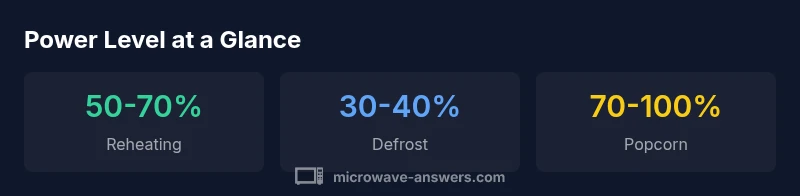
To answer what should microwave power level be, use the task as your guide: higher power for speed, lower power for even heating. For reheating leftovers, aim for about 50-70%; defrosting works best at 30-40%; and delicate items often benefit from 30-50%. Start mid-range, monitor progress, and adjust as needed.
Why power level matters
Food cooked in a microwave relies on turning microwaves into heat within the food. The power level you choose determines how quickly heat is delivered and how evenly it disperses. For many home cooks wondering what should microwave power level be, the short answer is: it depends on the task. According to Microwave Answers, different food types and containers respond differently to heat, so selecting the right setting reduces cold spots, overcooking edges, and soggy textures. Key ideas to keep in mind: higher power is faster but can overcook delicate foods or create dry edges; lower power encourages even heating and gentler cooking, but takes longer; letting food rest after microwaving can also improve texture and safety. A practical approach is to think in stages: start at a moderate setting, check progress, then adjust if needed. With a few simple habits, you can achieve reliable results across many dishes without guessing.
What should microwave power level be for common tasks
Different tasks demand different heat delivery. For many everyday needs, a mid-range setting around 60-80% balances speed with even heating. For some foods you’ll want higher power briefly and then lower power to finish gently. If you ask what should microwave power level be for reheating leftovers, aim for about 50-70% and pause to stir or flip halfway through. For popcorn, many models work best at 70-100% for short bursts, with careful monitoring. When defrosting, low power around 30-40% minimizes cooking while thawing. Always consider container type; glass or ceramic with a loose lid distributes heat more evenly than plastic wrap.
Defrosting vs. cooking: when to use lower vs higher power
Defrosting is not a one-size-fits-all operation. At 30-40% power, food thaws more gently, reducing the risk of starting to cook the outer layers while the inside remains frozen. For meat, this helps maintain texture and moisture; for vegetables, you avoid limp edges. If you need to cook directly from frozen, you may start at 40-50% and increase in stages as the center comes up to temperature. The right approach depends on thickness and density. A short rest after removing from the microwave helps carry heat to the center, improving doneness without overcooking the exterior.
Practical tips for dialing in the right power
- Know your microwave's wattage and how it translates to power level on your control panel.
- Start at a mid-range setting (about 50-70%) and check after 1–2 minutes.
- Stir, flip, or rearrange food halfway through to promote even heating.
- Use a shallow, wide container and cover with a vented lid to keep moisture balanced.
- Consider two-stage cooking: brief high-power bursts followed by a gentler finish.
- Let food rest for 1–3 minutes before serving to finalize heat distribution.
- Keep a small thermometer handy for foods that must reach a safe temperature.
- When in doubt, reheating in shorter intervals reduces the risk of overcooking.
Common mistakes and how to avoid them
- Over-relying on 100% power for all foods; this often creates hot edges and cold centers.
- Forgetting to stir or flip; quiet hotspots remain under-heated.
- Not accounting for container effects; plastic wrap can trap heat unevenly or melt.
- Not resting the food after microwaving; carryover heat matters for texture and safety.
- Using metal or foil accessories; they can cause arcing and damage the appliance.
- Rushing the process; patience yields more consistent results and reduces waste.
Quick-start power level guide for common foods (practical baseline)
For quick reference, use the following baselines and adjust to your model and preferences. Reheating leftovers: 50-70%; Defrosting: 30-40%; Beverages: 60-80%; Ready-to-eat meals: 60-75%; Frozen entrées: 50-60% for the initial stage, then finish with 70%.
Power-level guidance by common task
| Food Type | Recommended Power Level | Typical Cook Time |
|---|---|---|
| Popcorn | 70-100% | 2-4 min |
| Leftovers/Reheat | 50-70% | 3-6 min |
| Defrosting | 30-40% | 5-20 min |
| Beverages | 60-80% | 1-3 min |
Common Questions
What is the best power level for reheating leftovers?
Aim for 50-70% and stir halfway through to distribute heat evenly. If still cold in the center, continue in short increments rather than increasing power. Rest briefly before serving.
For reheating, start around half power and stir halfway, then adjust as needed.
Should I defrost at a lower power?
Yes, use 30-40% to thaw without cooking the outer layers. Check progress frequently and break apart large chunks to ensure even thawing.
Defrost at low power to thaw safely and evenly.
Can I cook directly from frozen foods?
Some foods tolerate cooking from frozen, but results vary. Start at 40-50% and monitor closely, using staged increases as the center warms.
You can for some items, but usually better to defrost first or use staged cooking.
How can I tell if I’m using the right power level?
Look for even texture and safe internal temperature. If edges are overcooked or center remains cold, adjust power in small increments and test again.
Check texture and temperature, then tweak the setting.
Does microwave wattage change recommended power levels across models?
Yes. Higher-wattage machines reach target temps faster; lower-wattage ones need adjustments. Always consult the user manual and test with quick samples.
Wattage matters; check your model’s manual and test with a small portion.
Is there a universal rule for foods and power levels?
There isn’t a universal rule. Use guidelines by food type, container, and personal preference, then tailor with small tests.
No universal rule—start with common guidelines and adjust.
“Power level is a sliding dial for heat delivery, not a single number. Using mid-range settings and staged cooking yields the most consistent results across foods.”
Main Points
- Start with mid-range power for most foods to balance speed and even heating
- Stir, flip, or rearrange food halfway to reduce hotspots
- Use defrost at 30-40% to thaw without cooking edges
- Let food rest after microwaving to finalize heat distribution
- Know your microwave wattage to translate power level accurately