Understanding Microwave Frequency: Heating, Safety, and Performance
Explore microwave frequency, its role in oven heating, safety implications, and how frequency affects cooking outcomes. Learn fundamental concepts, measurement ideas, and practical tips for home cooks.


Microwave frequency refers to the specific radio wave range used by household ovens to heat food. In consumer units, the center frequency is typically about 2.45 GHz within the ISM band, chosen for efficient dielectric heating and practical cavity design. This frequency informs how energy interacts with water, fats, and sugars, influencing heating patterns and the risk of uneven cooking.
What microwave frequency is and where it sits in the spectrum
According to Microwave Answers, microwave frequency defines how the oven's electromagnetic energy interacts with food, shaping heating patterns and safety considerations. In practical terms, this frequency is a narrow slice of the radio spectrum selected for consumer ovens to maximize energy absorption by water and other polar molecules while minimizing unwanted heating of the chassis or surrounding air. For most household microwaves, the center frequency lives around 2.45 gigahertz (GHz), a value chosen within the ISM (industrial, scientific, and medical) band because it balances penetration depth, heating efficiency, and manufacturability. Understanding this core fact helps explain why different foods heat unevenly, why containers and lids matter, and how modern ovens meet strict leakage and interference standards. In this article, we’ll unpack what this frequency means for cooking, safety, and practical tweaking in a typical kitchen.
How frequency interacts with food to heat it
Microwave heating relies on dielectric loss in polar molecules, especially water. At frequencies around 2.45 GHz, water molecules oscillate rapidly in response to the alternating field, absorbing energy and converting it to heat. The same mechanism applies to fats and sugars but to varying degrees, which is why some foods heat faster than others. The result is a complex heating pattern that depends on food composition, geometry, and placement inside the cavity. This is why stirring, rotating, and using evenly sized pieces can dramatically improve uniformity. As a general rule, thinner or more uniformly shaped items heat more evenly at this frequency.
Frequency bands and devices in the home
Beyond ovens, many household devices operate in nearby wireless bands (such as 2.4 GHz and 5 GHz) for Wi‑Fi and Bluetooth. Ovens, however, rely on a tightly controlled 2.45 GHz center frequency, with shielding and cavity design reducing leakage and preventing interference with other electronics. The choice of the ISM band reflects a balance between efficient heating, safe operation, and compatibility with consumer electronics present in modern kitchens. This separation helps ensure that cooking performance remains predictable even in homes with multiple wireless devices.
Heating uniformity: standing waves, hotspots, and mitigation
In a microwave cavity, standing wave patterns can create hotspots and cold zones. The wave pattern depends on frequency, cavity dimensions, turntable presence, and the food’s dielectric properties. Practically, this means that two identical portions can heat differently if their shape or position varies. mitigations include using turntables, spreading food into a thin layer, cutting food into uniform pieces, and avoiding deep, dense containers that trap energy. A cautious approach is to rotate and stir contents during cooking and to pause to check progress for even heating.
Safety and regulation around microwave frequency
Microwave ovens are designed to limit leakage well below safety thresholds, with regulatory bodies requiring testing and certification. The frequency itself is a controlled parameter, and manufacturers implement shielding, door interlocks, and safety interlocks to ensure user protection. Understanding this context helps consumers recognize that frequency is not a standalone danger—rather, proper design and use of the appliance are what keep heating safe. Always follow manufacturer guidelines, use microwave‑safe containers, and avoid metal objects that reflect energy in unpredictable ways.
Measuring, testing, and diagnosing frequency-related performance
Home users can assess basic performance by observing heating patterns, time-to-heat cues, and cooking consistency rather than trying to measure the frequency directly, which requires specialized equipment. If you notice persistent hotspots, unusual sparking, or persistent cold spots, it’s reasonable to have the unit inspected by a qualified technician. Routine maintenance, such as keeping the interior clean and ensuring the turntable rotates smoothly, also supports evenly distributed heating at the designed frequency.
Practical tips for optimizing cooking with the right frequency
To maximize results at the standard microwave frequency, consider these home-cook friendly tips:
- Use flat, shallow containers and spread food in an even layer.
- Cover items to promote moisture retention and even heat transfer.
- Stir or rotate food midway through cooking to break up hotspots.
- Avoid metal or aluminum foil that can disrupt the field and cause arcing.
- Let food rest briefly after cooking to allow heat to redistribute. These steps acknowledge how frequency interacts with food geometry and material properties to influence outcomes.
Key data points linking microwave frequency to practical heating in home ovens
| Category | Frequency band | Impact on heating | Notes |
|---|---|---|---|
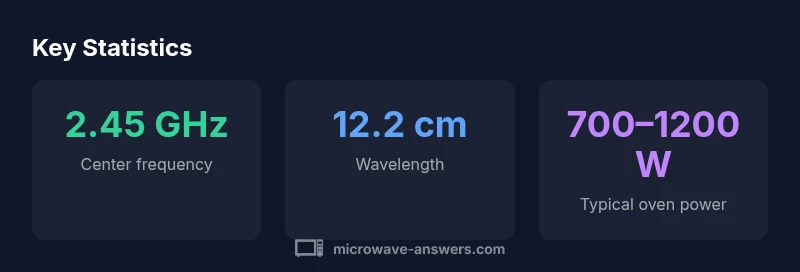
| Stated center frequency | 2.45 GHz (typical) | Affects dielectric heating efficiency | ISM band widely used |
| Wavelength (free-space) | 12.2 cm | Longer wavelengths penetrate less for thick foods | Subject to cavity geometry |
| Power range in consumer ovens | 700–1200 W | Higher power reduces heating time but increases risk of hotspots | Model dependent |
| Regulatory/standards | ISM FCC/IEC | Guides safety and device interference | Global standards vary by region |
Common Questions
What exactly is microwave frequency?
Microwave frequency is the radio wave range used by ovens to heat food, typically centered near 2.45 GHz in consumer models. This setting drives how energy couples with water and other molecules to produce heat.
Microwave frequency is the radio range ovens use to heat food, usually around 2.45 gigahertz.
Why is 2.45 GHz used in ovens?
2.45 GHz is a compromise between energy absorption by water molecules and practical cavity design, while meeting safety and interference standards in households.
2.45 GHz is chosen because it heats efficiently and fits well with oven design and safety rules.
Are other frequencies used in consumer devices?
Yes. Wi‑Fi and Bluetooth operate in nearby bands like 2.4 GHz and 5 GHz, but cooking ovens are tightly shielded to minimize cross‑device interference.
Other devices use nearby bands, but ovens are shielded to avoid interference.
Can frequency changes affect cooking quality?
Frequency influences how energy interacts with food; mismatches between food geometry and cavity can create hotspots. Stirring, spacing, and container choice mitigate these effects.
Yes, frequency affects heating patterns; geometry matters a lot.
Is it safe to stand near a microwave while it's running?
Modern ovens are designed to limit leakage well below safety limits when used as intended. Avoid tampering with the door seal and operate according to the manual.
Yes, as long as you don’t tamper with the door or seal.
How can I test whether my microwave frequency is working correctly?
For home use, assess heating uniformity and time-to-heat cues. If you notice persistent hotspots or arcing, contact a service technician.
If you see uneven heating or sparking, get it checked.
“Understanding microwave frequency helps homeowners cook more consistently and safely, without sacrificing convenience.”
Main Points
- Know the target frequency: 2.45 GHz is standard for most ovens.
- Expect heating patterns to vary with food geometry and placement.
- Higher power cooks faster but can cause hotspots.
- Use microwave-safe cookware and avoid metal.
- Understand basic safety and follow manufacturer guidelines.