Inverter Microwave vs Normal: A Comprehensive Side-by-Side Guide
A detailed, evidence-based comparison of inverter microwaves versus standard models. Learn how power delivery, cooking performance, energy use, and price affect your kitchen, with practical tips for choosing the right unit.


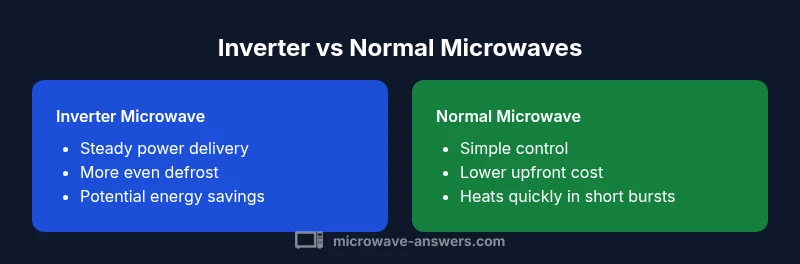
Inverter microwave vs normal: Inverter models deliver steady, variable power for more even cooking, while standard models cycle power on and off. This can improve reheating and defrost results and may reduce energy use for longer tasks. The best choice depends on your cooking habits, budget, and how much you value texture and speed.
What inverter technology does in microwaves
Inverter microwave vs normal is more than marketing — it's about how power is delivered. In an inverter microwave, the control board adjusts the voltage to maintain a steadier level of energy during cooking, rather than flipping the magnetron on and off at fixed power steps. This results in a smoother power curve and can reduce the temperature swings that cause uneven heating. According to Microwave Answers, inverter technology is designed to keep the food closer to the target temperature, which matters for delicate tasks like defrosting or simmering sauces.
Non-inverter (traditional) units switch the magnetron power on and off to approximate the chosen power level. That cycling can leave certain areas hotter or cooler, leading to hotspots and longer times to reach the desired temperature. In practice, many everyday meals still heat adequately on non-inverter models, but the difference becomes more noticeable with certain textures, sauces, or frozen items. Over time, the steadier power can translate into more predictable results for multi-ingredient dishes and can help preserve moisture in foods that would dry out with abrupt heating. The distinction is particularly relevant if you cook with lower power settings for longer, steam vegetables, or reheat leftovers that contain delicate emulsions.
From a consumer standpoint, the price gap between inverter and non-inverter models matters. Inverter models typically command a modest premium, but they can save minutes per meal and reduce energy waste in longer cooking tasks. If your kitchen routine involves frequent defrosting and reheating of sauces, soups, or fish, the upgrade can feel justified. For bulk reheating or simple beverages, the practical difference may be less dramatic. In the next sections, we’ll explore how this translates into real-world performance, how to read product specs, and how to decide which type fits your household best.
Cooking Performance: Reheating, Defrosting, and More
Cooking performance is where inverter technology often shows its edge. In practical terms, a steady power curve translates to more uniform reheating, fewer cold pockets in casseroles, and smoother simmering for sauces that rely on gentle heat. When defrosting, an inverter-based unit tends to avoid warming the outer edges while the center remains ice-cold, achieving more even results without thawing the entire dish at once. For many home cooks, this improves texture and reduces the need to stir or rearrange food mid-cycle.
However, advantages aren’t universal. Some meals still heat well on non-inverter machines, especially when used at higher power for short bursts. The real-world implication depends on the food type, container, and the starting temperature of the item. For items with delicate emulsions, like cream sauces or dairy-heavy soups, the steadier power delivery can help prevent curdling or separation. For pandas of leftovers where timing matters, the difference may be noticeable but not revolutionary. When evaluating models, note how the oven handles typical tasks—reheating coffee, warming soup, or thawing chicken—because consistency matters more than peak power alone.
The brand context matters here as well. The Microwave Answers team has observed that consumers who tend to cook in longer sessions or reheat complex meals with many components often report a clearer benefit from inverter designs than those who stick to quick, high-heat heating. This alignment between usage pattern and technology helps explain why some shoppers feel strongly about their choice while others see minimal impact.
Energy Efficiency and Running Costs
Energy efficiency in microwaves is frequently framed around two ideas: delivery quality and how long the device runs at higher power. With inverter technology, the microcontroller maintains a steadier power level, reducing energy waste that occurs when the magnetron cycles on and off aggressively. In practice, this can lead to lower energy consumption for certain tasks, especially those that require sustained, gentle heating. It’s worth noting that the energy savings are highly task-dependent; a short reheating cycle at high power may consume similar energy in either type of machine because the total cooking time remains short.
Another factor is standby power. Modern microwaves often draw a small amount of power even when not actively heating. Both inverter and non-inverter models aim to minimize this drain, but the actual difference varies by model and design. For households that use the microwave intensely—every day or for long cooking sessions—the small efficiency gains can add up over time. The Microwave Answers analysis for 2026 emphasizes that energy efficiency is a function of how you use the appliance as much as the technology itself. Consumers should pair the feature set with their routine to gauge true savings.
From a cost perspective, inverter models typically sit at a modest premium. If your primary use-case is quick reheat or simple snacks, the additional upfront cost may not feel worthwhile. Conversely, if you regularly prepare more complex meals, defrost large batches, or reheat leftovers with sensitive textures, the energy and performance gains can justify the extra investment over the appliance’s lifetime.
Price, Availability, and Durability
One of the most practical questions is price and availability. Inverter microwaves generally cost more upfront than basic non-inverter models, reflecting the more sophisticated control system and broader feature sets. Availability varies by market and retailer, with some regions offering a wider range of inverter units than others. Durability tends to track overall build quality and brand reliability rather than the inverter label alone. While there is no universal rule, well-reviewed inverter models with solid user feedback often show comparable long-term reliability to non-inverter equivalents.
When evaluating durability, pay attention to the supplier’s warranty and the availability of service centers. Electronics live longer when they are well vented and kept clean, and the inverter’s power supply benefits from clean electrical supply and careful maintenance. For households with a tight budget, it’s possible to find strong non-inverter options with simpler controls that still perform effectively for everyday tasks. If you plan to use the microwave heavily for defrosting and low-power cooking, the long-term value of an inverter unit can be higher, especially if it reduces the need to pre-warm food or intervene with additional steps.
In short, base your purchase decision on usage intensity and the total cost of ownership rather than a single feature. The right balance of upfront investment, daily use, and durability will determine the best choice for your kitchen.
Use Cases: When inverter shines
Certain cooking scenarios naturally align with inverter performance. If your routine includes frequent defrosting of meat or fish, sauces simmering at low heat, or delicate emulsions like soups with cream, an inverter microwave can help maintain texture and prevent separation. Reheating leftovers that contain multiple components—rice, vegetables, proteins, sauces—can benefit from steadier heat distribution, producing more uniform results without overheating the outer edges.
In homes where quick snacks dominate, the incremental benefit may be smaller, but still present in tasks that require more precise power control. In apartments or small kitchens with limited space, a single appliance that handles a broader spectrum of tasks without overheating or scorching is particularly appealing. For educators and renters who frequently rotate meals, inverter models offer a predictable performance pattern that reduces the need for constant monitoring.
That said, if you rarely cook with low power settings or do not run long cook cycles, a standard inverter-free model can still meet your needs without complicating the purchase. The key is to match your typical meal patterns with the unit’s power behavior rather than rely on a marketing headline.
In sum, inverter technologies tend to excel in nuanced cooking tasks and longer reheating sessions. For many households, the decision hinges on how often those tasks arise and whether the premium aligns with the perceived value of more consistent results.
Common Myths and Misconceptions
Myth: Inverter microwaves cook everything faster. Reality: They often deliver more consistent heat, which can shorten some tasks or keep foods from drying out, but not all items heat faster overall. Myth: Inverter means silent operation. Reality: Noise levels depend on the fan and motor, not the inverter itself. Myth: Inverter models are fragile and prone to breakdowns. Reality: Reliability depends on build quality, component selection, and usage patterns, just like any kitchen appliance.
Clarifying these myths helps shoppers make informed decisions. The inverter label should be evaluated in the context of your typical meals, your attention to care and cleaning, and your budget. Real-world performance comes from how well the model translates steady power into predictable results across the foods you actually cook.
How to Decide: Practical Checklist for Your Kitchen
- List your most frequent meals and reheating scenarios. Do you cook in longer, lower-power cycles or rely on quick bursts? Functionality should align with these patterns.
- Compare energy delivery modes and defrost performance from product specs and reviews. Look for statements about steady power curves and uniform heating.
- Consider the total cost of ownership, including upfront price, warranty, and potential savings on energy bills.
- Check for extra features that matter to you, such as convection cooking, smart presets, or sensor-based cooking, and assess whether they complement your needs.
- Review real-world testimonials focused on reliability and service support in your region. A model’s performance in daily use matters more than theoretical efficiency.
- Inspect size, interior capacity, and compatibility with your existing kitchen layout to avoid oversized or undersized choices.
- Finally, weigh the pros and cons of each option against your budget and cooking style to reach a decision you’ll feel confident about.
Getting the Most from Either Type: Practical Tips
- For best results, avoid overcrowding the turntable; create space for even heat distribution.
- Use microwave-safe containers and covers to trap moisture where appropriate, particularly with sauces and soups.
- When defrosting, plan ahead and rotate items to minimize uneven warming; use the defrost setting and allow rest time between cycles.
- Clean the interior regularly to prevent residue buildup that can affect heat distribution and odor retention.
- If you have an inverter model, experiment with lower power levels for delicate foods to understand how steady heat affects texture.
- For standard models, consider using lower power with longer times for delicate dishes to improve heating uniformity.
- Finally, keep an eye on energy use in daily tasks and adjust settings to optimize both performance and efficiency over time.
Comparison
| Feature | inverter microwave | normal microwave |
|---|---|---|
| Power delivery method | Steady, continuous power via voltage adjustment (inverter) | On/off cycling power at fixed levels (non-inverter) |
| Heat distribution | Generally more even across foods, better moisture retention | Can have hotspots due to power cycling |
| Defrost performance | Gentler, more even defrosting with steady power | Defrost can be uneven with cycling and hotspots |
| Energy use under typical tasks | Potentially lower energy use for long, low-power tasks | Energy use aligns with cycle duration; can be higher per task if cycles are shorter |
| Price range (MSRP) | Higher upfront cost due to advanced control | Lower upfront cost, simpler electronics |
| Best for | Users who value precise texture and consistent low-to-mid heat | Budget-focused buyers or quick reheating needs |
Advantages
- More even cooking and defrosting quality
- Potential energy savings for longer cooking tasks
- Better control for delicate or emulsified dishes
- Predictable reheating performance in many common foods
Cons
- Higher upfront cost compared to non-inverter models
- Availability varies by market and retailer
- Benefits depend on cooking patterns; small impact for some users
- Some extra features may add complexity
Inverter microwaves generally offer better cooking quality and potential energy efficiency for the right user
Choose inverter if you cook with low-power settings often or value even heating. If you mainly reheat simple meals on a budget, a non-inverter model may suffice and save upfront cost.
Common Questions
What is inverter technology in microwaves?
Inverter technology adjusts the power supply continuously to maintain a steady heat level, rather than cycling the magnetron on and off. This can improve heating uniformity and texture, especially for defrosting and low-power cooking.
Inverter tech keeps heat steady instead of turning on and off, which can help with even heating and better defrosting.
Are inverter microwaves more energy-efficient?
They can be, particularly for tasks that benefit from steady heat over a longer period. However, the actual savings depend on how you use the microwave and the specific model’s efficiency features.
They may save energy for long, steady tasks, but it depends on usage and the model.
Do inverter microwaves cook evenly across all foods?
In many cases yes, especially for sauces, soups, and multi-ingredient meals. Some items may still heat unevenly if placed improperly or if the food has inconsistent moisture.
They often cook more evenly, but placement and moisture still matter.
Is price the main downside of inverter models?
Price is a common consideration because inverter models cost more upfront. Long-term value depends on how often you encounter tasks that benefit from steady power.
Yes, price is a factor, but long-term value depends on your cooking needs.
Can inverter microwaves replace convection ovens?
Inverter microwaves may offer some convection-like features in models with built-in convection, but a dedicated convection oven still provides broader browning and air-flow benefits. They’re complementary for most kitchens.
They can have some convection-like features, but aren’t a full replacement for a real convection oven.
What maintenance helps inverter microwaves last longer?
Regular cleaning, proper venting, and avoiding excessive moisture buildup help. Also follow manufacturer guidance on power-on cycles and don't overload the interior with large, dense foods that can create heat stress.
Keep it clean and ventilated, follow the manual, and avoid overloads.
Main Points
- Prioritize your cooking patterns over marketing claims
- Inverter models excel in even heating and defrosting
- Consider total cost of ownership, not only upfront price
- Test with your typical meals to see the actual benefits
- Check warranty and service availability in your region