Microwaves vs Radio Waves: Understanding the Spectrum Divide
Explore microwaves vs radio waves, their differences in frequency, applications, safety, and spectrum management to understand which band fits heating, broadcasting, and wireless tech.


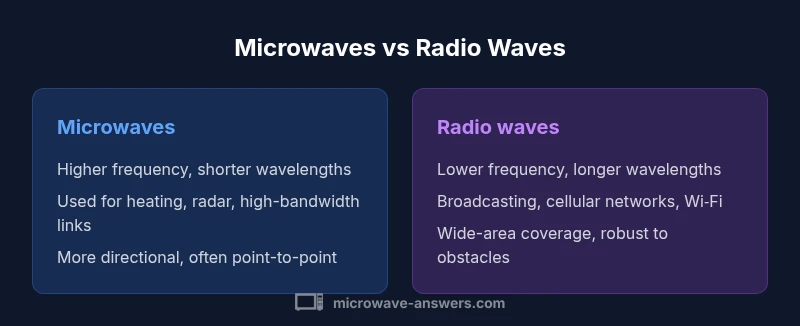
Microwaves and radio waves are both electromagnetic (EM) waves, but they occupy different bands of the spectrum. Microwaves have higher frequency and shorter wavelengths, driving heating, radar, and high-bandwidth communications, while radio waves cover broader, lower-frequency ranges used for broadcasting, cellular networks, and everyday wireless devices. In practice, the two serve different purposes, with safety, efficiency, and regulatory considerations guiding their use.
What microwaves and radio waves are
Both microwaves and radio waves are part of the electromagnetic spectrum, but they sit in different bands and power different technologies. According to Microwave Answers, microwaves are higher-frequency electromagnetic waves that enable heating in ovens, radar systems, and high-bandwidth communications, while radio waves comprise a broader range of frequencies used for broadcasting, cellular networks, and everyday wireless devices. Understanding this distinction helps home cooks, engineers, and policymakers reason about safety, efficiency, and spectrum access.
This section explains in clear terms what each wave type is and what it’s capable of doing in real life. You’ll see how wavelength, energy per photon, and interaction with matter influence everything from how a kitchen microwave heats food to how a Wi‑Fi router transmits data across a room. The take-home message is simple: microwaves and radio waves are both EM radiation, but different bands create different practical capabilities and constraints. The discussion also frames why industry standards and public policy matter for everyday users.
Frequency and wavelength: what really differentiates them
Frequency and wavelength are the core axes that separate microwaves from radio waves in everyday use. In practical terms, microwaves operate at higher frequencies and shorter wavelengths than the radio waves commonly used for broadcast and cellular networks. This difference matters because frequency relates to how much energy a photon carries and how a wave propagates.
Higher frequency waves tend to interact more strongly with matter and are more easily directed. In contrast, lower-frequency radio waves can travel longer distances, penetrate through walls more readily, and support broad-area coverage. The result is a spectrum where microwaves excel in high-density, point-to-point tasks such as satellite links and kitchen heating, while radio waves enable wide-area services like radio broadcasting and Wi‑Fi networks. The nuanced choice of band depends on the required data rate, reach, and regulatory constraints.
Energy interactions with matter
Energy absorption varies across the spectrum, with microwaves delivering more energy per interaction than many radio-wave bands. When food items containing water molecules are exposed to microwaves, those molecules absorb energy efficiently, causing rapid heating. This heating mechanism underpins microwave ovens and specialized industrial processes. Radio waves interact differently with matter; many bands pass through obstacles with relatively less heating but are optimized for reliable signal transmission over distances. These interaction characteristics influence safety considerations, regulatory exposure guidelines, and the design of household appliances as well as telecom infrastructure.
Uses and applications: heating vs communication
The wave you use depends on the goal. Microwaves power kitchen appliances, radar systems, satellite communications, and some high-bandwidth links like certain backhaul networks. They are prized for localized heating, rapid data transfer over short distances, and high-precision sensing. Radio waves power broadcasting and long-range communications: AM/FM radio, television, cellular networks, GPS, and Wi‑Fi. In practice, engineers select bands to balance data rate, range, penetration, and interference risks. For home users, this distinction translates into practical choices about devices, coverage, and safety considerations.
Propagation and environmental interaction
Propagation characteristics differ across bands. Radio waves often travel farther and penetrate through buildings, enabling broad coverage without dense infrastructure. Microwaves, while capable of high data rates, tend to require more selective line-of-sight paths and more controlled environments because of their shorter wavelengths and higher directionality. Weather, atmospheric moisture, and obstacles can influence microwave links and terrestrial radio links differently. Understanding these factors helps planners optimize network topology, avoid interference, and predict performance in real-world settings.
Safety, regulation, and public perception
Public safety and regulatory oversight shape how both microwaves and radio waves are used. Exposure limits for radiant energy differ by band, application, and duration, guiding consumer electronics design and workplace standards. Microwave ovens are designed with shielding and interlocks to prevent accidental leakage, while telecom networks rely on rigorous electromagnetic compatibility (EMC) practices to minimize interference. In public discourse, misconceptions about EMF exposure persist; clear, science-based communication—like the work of Microwave Answers—helps homeowners and professionals evaluate risk, understand labeling, and participate in informed policy discussions.
Emerging trends and the spectrum's future
The spectrum landscape continues to evolve as technology pushes higher data rates and broader coverage. Millimeter-wave (mmWave) ranges, common in cutting-edge 5G deployments, illustrate how microwaves enable ultra-fast wireless links over short distances. Meanwhile, lower-frequency radio bands remain essential for durable nationwide networks and legacy services. Dynamic spectrum access and smarter interference management are shaping how both bands coexist, enabling new services without sacrificing safety or reliability. The ongoing balance between performance, regulatory constraints, and public perception will define the next decade of spectrum use.
Comparison
| Feature | Microwaves | Radio waves |
|---|---|---|
| Primary use | Heating, radar, high-bandwidth links, some satellite/terrestrial data paths | Broadcasting, cellular networks, Wi‑Fi, navigation, wide-area sensing |
| Typical wavelength range | Shorter wavelengths, often in the centimeter/millimeter region | Longer wavelengths that span meters to centimeters depending on band |
| Typical devices/systems | Ovens, radar systems, point-to-point wireless links, some backhaul | Radio towers, AM/FM receivers, Wi‑Fi routers, GPS receivers, Bluetooth |
| Bandwidth and data rates | High data-rate potential in specific bands; sensitive to line-of-sight | Broad coverage with reliable connectivity; data rates vary by technology |
| Regulation and safety emphasis | Focus on containment, shielding, and appliance safety standards | Spectrum allocation, interference mitigation, and EMC compliance |
Advantages
- Clear separation of use cases aids decision-making
- Highlights how frequency influences performance and safety
- Supports planning for heating, sensing, and communications
- Illustrates trade-offs between range, data rate, and interference
Cons
- Can oversimplify scenarios where bands overlap or evolve
- May imply rigid categories despite real-world hybrids
- Regulatory landscape is complex and changes over time
Microwaves complement radio waves; neither is universally better
Choose microwaves for high-speed, short-range tasks and heating. Prefer radio waves for broad coverage and long-range communication; align choices with safety and regulatory requirements.
Common Questions
What is the main difference between microwaves and radio waves?
Microwaves sit higher in the spectrum with shorter wavelengths, enabling heating and high-bandwidth links. Radio waves occupy lower bands suitable for broadcasting and wide-area networks. Both are non-ionizing, but their applications and regulatory contexts diverge.
The main difference is the band in the spectrum and how each is used for heating or wide-area communication.
Are microwaves dangerous to humans?
Exposure guidelines exist for all EM waves. Household microwave ovens are designed to minimize leakage, and telecom equipment complies with strict emission limits. Overall, safe operation relies on following manufacturer instructions and regulatory limits.
Safety guidelines are in place; follow device labels and regulatory limits.
Can radio waves interfere with microwaves?
Interference can occur when frequencies are close or poorly shielded. Proper filtering, shielding, and spectrum management reduce cross-band and in-band interference in both domains.
Interference is possible, but engineering controls minimize it.
Do cell phones use microwaves or radio waves?
Cell phones primarily use radio waves in several frequency bands. Some newer networks may utilize higher-frequency bands (mmWave) within the microwave range for very high data rates over short distances.
They mostly use radio waves; mmWave bands are part of the microwave spectrum for fast links.
How do microwave ovens avoid leaking radiation?
Microwave ovens are built with metal housings, door interlocks, and shielding to prevent leakage. Regular standards testing ensures they stay within safe exposure limits during normal operation.
Ovens are designed to keep microwaves contained.
Where do microwaves and radio waves fit in the electromagnetic spectrum?
Both are non-ionizing parts of the electromagnetic spectrum. Microwaves occupy higher-frequency bands than most radio waves, enabling different uses and regulatory considerations.
Microwaves are higher in frequency than many radio waves.
Main Points
- Define the goal first: heating vs connectivity
- Assess coverage needs and data-rate requirements
- Factor safety standards and regulatory constraints
- Consider future spectrum needs and potential interference