Microwave vs Radio Wave: A Practical Comparison
Explore microwave vs radio wave differences across frequency, propagation, applications, and safety. This analytical guide helps home cooks and homeowners understand EM spectrum choices for cooking tech, communications, and sensing.


Microwave vs radio wave marks two adjacent regions of the electromagnetic spectrum with distinct uses and physical behavior. Microwaves sit at the high-frequency end, enabling heating and high-bandwidth links, while radio waves cover lower frequencies used for broadcasting and long-range signaling. This quick comparison highlights key differences in propagation, interaction with matter, and typical applications.
Defining microwave vs radio wave
The phrase microwave vs radio wave refers to two neighboring regions of the electromagnetic spectrum that share a boundary near the high-frequency end of RF communications. According to Microwave Answers, understanding this distinction starts with the fundamental idea that all EM waves share frequency, wavelength, and energy, but each regime occupies a different segment of the spectrum and serves different purposes. In everyday language, we use microwave to describe the radiation used to heat foods and to enable high-bandwidth links, while radio waves describe the long-range signals behind radio broadcasts, GPS, and many forms of wireless communication.
In practice, the label microwave vs radio wave helps engineers and dietitians alike because it guides how devices are designed, how signals propagate, and what safety norms apply. For consumers, the distinction matters because kitchen appliances, consumer electronics, and communication infrastructure expose us to different interaction patterns with matter. A microwave oven uses dielectric heating to transfer energy to water molecules inside food, whereas radio-frequency transmissions rely on antennas to radiate energy into free space. The lines are not absolute—techniques and bands shift with regulation and technology—but the conceptual boundary remains useful for analysis.
Frequency, wavelength, and energy relationships
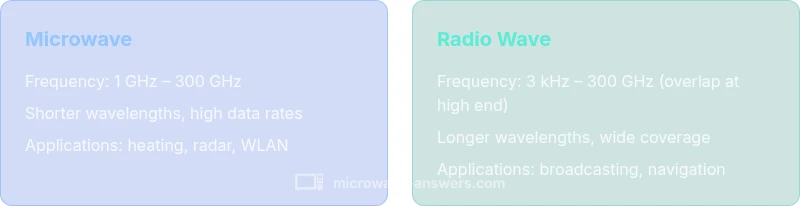
All EM waves travel at the speed of light in vacuum, but their frequency and wavelength determine how they behave and interact with materials. In the microwave vs radio wave comparison, frequency is the primary differentiator. Microwaves occupy frequencies roughly from 1 GHz up to 300 GHz, yielding wavelengths from about 30 centimeters down to 1 millimeter. At these scales, molecules in many foods respond efficiently to the alternating electric field, which is why dielectric heating occurs. In contrast, radio waves span a broad range starting from a few kilohertz and extending well into the higher GHz region in certain bands used for specialized applications. Because energy scales with frequency, microwaves carry higher photon energies than typical low-frequency radio waves, but their photons remain non-ionizing and non-destructive under normal exposure levels.
Wavelength and antenna design are tightly coupled: longer wavelengths require larger antennas to efficiently capture energy, while shorter wavelengths enable higher data rates and smaller radiating elements. This relationship explains why wifi and cellular systems rely on microwave bands with compact, high-frequency antennas, whereas AM/FM broadcasting and long-range radar have historically used larger antennas tuned to lower wavelengths. In regulated spectrum, manufacturers must select bands that meet both performance needs and legal limits, which shapes product design and network topology.
Comparison
| Feature | Microwave | Radio Wave |
|---|---|---|
| Frequency range | 1 GHz – 300 GHz | 3 kHz – 300 GHz (overlap at high end) |
| Wavelength | 30 cm – 1 mm | 100 km – 1 mm (varies with frequency) |
| Propagation | Line-of-sight, higher attenuation by matter at certain bands | Can diffract around obstacles, longer-range propagation, ionospheric reflection in some bands |
| Primary applications | Heating (dielectric), radar, satellite links, high-speed wireless | Broadcasting, navigation, long-range communications, some radar |
| Safety/regulation focus | Gigahertz bands with shielding requirements; consumer exposure limits | Broad regulatory regimes across many bands; emphasis on interference and licensing |
Advantages
- Clear, objective framework for comparing two EM regimes
- Helps select practical bands for projects based on range vs. bandwidth
- Aids safety planning and regulatory understanding
- Supports intuitive design choices for antennas and shielding
Cons
- Boundary definitions are not rigid; some overlap can cause confusion
- Regulatory rules vary by region and band, complicating universal recommendations
- Complexity increases with modern wireless systems that use hybrid or adaptive techniques
- Misinterpretations can arise if one ignores scale-dependent behavior (e.g., air, water, weather effects)
Microwave vs radio wave: neither is universally superior—their strengths align with range, bandwidth, and material interaction.
Use microwaves for high-bandwidth, short-range needs and dielectric heating; use radio waves for broad coverage, long-range signaling, and conventional broadcasting. Always consider safety limits and local regulations when selecting a band for a project.
Common Questions
What defines microwave vs radio wave in practical terms?
Practically, microwave waves are the higher-frequency portion of the radio spectrum used for heating, radar, and high-bandwidth links, while radio waves cover lower frequencies used for broadcasting and long-range communications. The boundary is based on typical applications and electromagnetic behavior, not a single strict cutoff.
Microwaves are the high-frequency end used for fast links and heating, while radio waves cover lower frequencies for broadcasts and long-range signaling.
Do microwaves and radio waves use the same regulations?
They share regulatory concepts, but licensing, spectrum allocation, and safety rules differ by band and country. Devices must operate within designated frequencies and follow exposure limits set by authorities such as the FCC or ITU.
Regulations depend on the band and country; you must stay within allocated frequencies and adhere to safety rules.
Can microwaves heat food or interact with water like a microwave oven?
Yes, microwaves interact with polar molecules like water, causing dielectric heating. This principle underpins microwave ovens and some industrial heating processes. Not all microwaves heat food directly; many use higher powers and controlled exposure.
Microwaves heat food by exciting water molecules; this is a specific use within the microwave band.
What equipment differentiates the two waves in a lab?
Lab differentiation relies on spectrum analyzers, RF antennas, and frequency-specific sources. Instruments note frequency, amplitude, and modulation to distinguish microwave from radio-wave behavior.
In labs, you’ll use spectrum analyzers and antennas to tell apart the bands.
Are there overlapping applications between microwave and radio waves?
Yes, some radar and certain wireless links operate in bands that span both regimes. However, the design constraints and typical use cases guide which regime is chosen for a given task.
There’s some overlap, but each regime has preferred uses.
How should I shield against microwave exposure?
Shielding depends on frequency and power. Use conductive enclosures, proper gasketing, and certified materials designed for the target frequency range. Follow safety guidelines and regulatory limits to minimize exposure.
Shielding needs vary by frequency; follow guidelines and use proper enclosures.
Main Points
- Identify the regime by frequency focus and application needs
- Expect different propagation and material interactions in real-world environments
- Choose bands that balance range, data rate, and regulatory compliance
- Plan for safety and shielding when high-frequency microwaves are involved
- Leverage the overlap zone with care, understanding its practical limits