How Many Microwaves Can Be On One Circuit: A Practical Guide
Learn how many microwaves can safely run on a single 120V circuit with a practical calculator, clear examples, and essential safety tips from Microwave Answers. Ideal for home cooks evaluating kitchen layouts.


Why circuit capacity matters for microwaves
According to Microwave Answers, understanding circuit capacity helps prevent nuisance breaker trips, overcrowding, and unsafe loads in busy kitchens. The question of how many microwaves can be on one circuit isn't just curiosity—it affects safety and performance. Microwaves draw high power in short bursts, and kitchens host several other devices (refrigerators, toasters, coffee makers, and more). If you push a circuit beyond its limit, you risk tripping breakers, overheating cords, and uneven performance. Grasping these basics empowers you to plan placements, prevent outages during cooking, and extend the life of your appliances. This section lays the groundwork so you can estimate load quickly and confidently, even when you’re shopping for a new unit.
The basic calculation: watts, volts, current
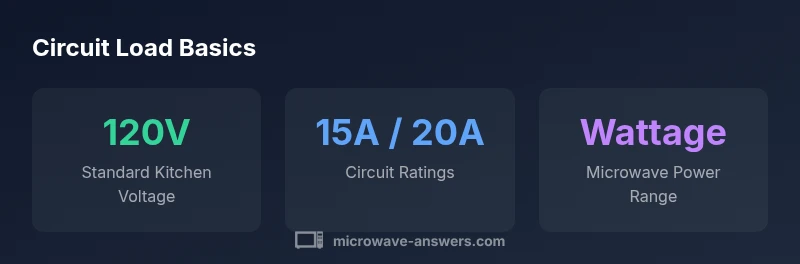
Electric circuits are defined by voltage (volts), current (amps), and power (watts). In most US kitchens, circuits run at 120V. The common circuit ratings are 15A or 20A. A simple, conservative estimate is maxMicrowaves ≈ round((circuitAmps * 120) / microwaveWattage). This assumes each microwave operates near its labeled wattage and that there aren’t other heavy loads on the same circuit. In practice, you should reduce this number to accommodate other devices and the 80% guideline for continuous loads. The calculator in this guide uses the same approach for quick, repeatable estimates. Real-world factors like startup surges or uneven load distribution can affect results.
How many microwaves can be on one circuit
To answer the core question, compare the circuit limit with each microwave’s wattage. On a 15A circuit (about 1800W), the math suggests you could run around 1 to 2 microwaves depending on wattage. Smaller models around 600–800W might allow 2–3 units, while larger 1000–1200W microwaves typically cap at 1–2. The exact number depends on how aggressively you use other kitchen devices at the same time. This is a practical approximation for planning, not a guaranteed electrical rating. The aim is to avoid tripping breakers and overheating cords.
Example scenarios for 15A vs 20A circuits
Consider these real-world scenarios to illustrate the differences. A 15A circuit (≈1800W) with two 1000W microwaves would reach about 2000W, which exceeds the circuit capacity and risks tripping. With two 600W microwaves on the same circuit, total is 1200W (well within the limit), and you could potentially add a small appliance if the load stays modest. On a 20A circuit (≈2400W), two 1000W microwaves are comfortably within rating, while a third 1000W unit would push toward the limit. Always plan for peak usage and other loads when sizing circuits.
Safety considerations and NEC guidance
Electrical safety and code compliance matter more than convenience. The NEC (National Electrical Code) favors dedicated circuits for high-wattage appliances when possible, especially in busy kitchens. A microwave is a high-load device; sharing a circuit with other heavy appliances can cause nuisance trips and heat buildup. For built-in or premium models, many jurisdictions encourage or require dedicated circuits. If you’re unsure, consult a licensed electrician to review your kitchen layout and panel capacity. Remember: safety and reliability come first.
Derating and other loads in the kitchen
Your kitchen isn’t just a single microwave. It hosts a range of devices—refrigerators, dishwashers, toasters, disposals, and vent hoods—all contributing to the circuit load. Even if a calculator suggests a comfortable number, real-world usage often means you’ll run several loads at once. Derating (reducing the calculated maximum) helps avoid overload. A practical rule is to assume multiple small to mid-size loads could be active during dinner prep. The more devices on one circuit, the more cautious you should be about simultaneous operation.
Using the calculator: step-by-step
Our calculator takes two inputs: circuitAmps and microwaveWattage. It uses the standard 120V voltage and rounds the result to the nearest whole number for a quick, usable estimate. Steps: enter your circuit’s amp rating, enter your microwave wattage (or range), press calculate, review the result, and then consider other kitchen loads. The output helps you decide whether you should spread loads across multiple circuits or upgrade wiring where needed.
Common mistakes to avoid
Avoid assuming that two microwaves on a 15A circuit are always safe. Startup surges and longer cooking cycles can push total load temporarily, causing trips or overheating. Don’t forget about other devices running at the same time. Avoid relying on
pushed numbers alone; always cross-check with a real-world test and, if in doubt, upgrade to a higher-capacity circuit or dedicated line. When possible, keep microwaves on separate, clearly labeled circuits and schedule high-wattage cooking away from other heavy loads.
Quick-reference guidelines for home kitchens
- Most 15A kitchen circuits can safely support a single 1000W microwave and perhaps a second smaller one if used separately. - A 20A circuit provides more flexibility for multiple units but still benefits from load planning. - For built-in microwaves or multiple high-wattage units, consider dedicated circuits installed by a professional. - Always verify total load during peak usage and avoid concurrent operation of other major appliances on the same circuit. - Use our calculator to model your exact setup and adjust for other loads in real time.