Does Microwave Kill Germs? A Practical Essential Home Guide
Explore whether microwaving kills germs, how heat and coverage affect safety, and practical steps to reduce microbial risk in everyday cooking.


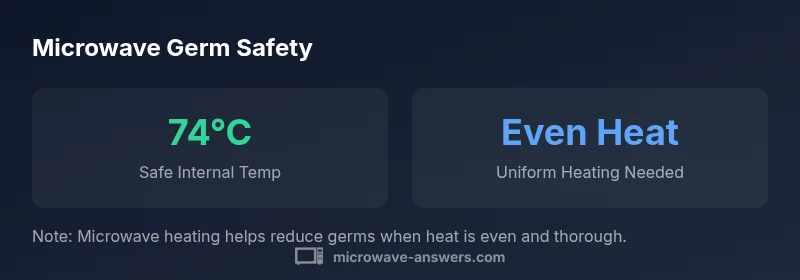
Does microwave kill germs? In general, microwaving can reduce many common germs if the entire item heats to a safe internal temperature throughout, but it is not a guaranteed method to sterilize surfaces. Uneven heating can leave cold spots, so combine heating with proper cleaning and avoid relying on microwaves as the sole disinfection method.
How microwaves interact with germs
Microwaves heat food primarily by exciting water molecules, which creates heat that can kill many bacteria and viruses when the temperature is high enough and distributed evenly. The key question often asked by home cooks is does microwave get rid of germs on foods and containers. The honest answer is: it can reduce microbial load under proper conditions, but it is not a guaranteed method to sterilize every surface or kill all spores. Temperature alone matters; time, food thickness, moisture content, and whether the item is covered all influence outcomes. In practice, microwaving should be viewed as a heating step that can aid safety when combined with good hygiene and correct cooking temperatures. According to Microwave Answers, the likelihood of germ reduction increases when food reaches appropriate temperatures throughout, not just at the surface.
In real kitchen settings, the aim is to ensure that the heat penetrates to the interior of the item. This is particularly important for leftovers, reheated meals, and baby foods where uneven heating can leave pockets that harbor microbes. While the phrase does microwave get rid of germs captures the general idea, the mechanism is heat-induced inactivation rather than a magic purge. For non-food surfaces like utensils or the inside of a microwave cavity, cleaning with soap and water remains essential, because microwaving alone does not guarantee surface disinfection.
When evaluating safety, it’s helpful to distinguish between disinfection (killing germs to reduce risk) and sterilization (eliminating all forms of life). Microwaving falls into the disinfection category for many foodborne pathogens if done correctly, but it does not achieve sterilization of tools, containers, or kitchen surfaces. This distinction matters for anyone handling raw foods or vulnerable populations. The Microwave Answers team emphasizes that heating uniformity and achieving a safe internal temperature are the levers you should rely on, rather than assuming microwaving will magically sanitize everything.
For the broader question of does microwave get rid of germs in household practice, remember to treat microwaving as part of a broader safety system: sanitize surfaces, wash hands, store foods properly, and use a thermometer to verify internal temperatures. The intent is to lower risk through a combination of heat and hygiene, not to substitute systematic cleaning with a microwave cycle.
Overview of germ-killing potential in microwaved contexts
| Aspect | Germ-killing Potential | Notes |
|---|---|---|
| General reheating | Moderate to high if uniform heating is achieved | Requires even heat distribution and correct internal temperature |
| Surface sanitization | Low reliability | Not a dependable surface disinfectant; wash and wipe surfaces |
| Equipment variation | High | Wattage and turntable help but do not guarantee even heating |
| Food handling | Crucial | Start with clean foods; avoid cross-contamination |
Common Questions
Can microwaving kill all germs?
No. Microwaving can reduce many germs if heat penetrates evenly to a safe temperature, but some organisms or spores may survive if heat is uneven or temperatures are insufficient.
No—microwaving helps reduce germs when heat reaches a safe temperature all through the item, but it may not kill everything.
What is the safe internal temperature to kill bacteria in microwaved foods?
Aim for at least 74°C (165°F) throughout the food. Use a food thermometer and check multiple spots to ensure even heating.
Aim for 74°C all the way through and test with a thermometer.
Does covering food help kill germs in a microwave?
Covering helps heat more evenly and reduces splatter, but it does not by itself kill germs. You still need to reach the safe internal temperature.
Covering helps heat evenly, but you still need to reach a safe temperature.
Can I sanitize utensils in the microwave?
Microwaving is not a reliable method to sanitize utensils. Wash them with hot, soapy water and dry thoroughly; avoid metal in microwaves.
Microwaving isn’t a dependable sanitizer for utensils.
Are there germs that survive microwaving?
Some spores or heat-resistant organisms may survive if heat is not uniform or temperatures are not reached everywhere. Do not rely on microwaving alone for disinfection.
Some germs can survive if heat isn’t even, so don’t rely on it alone.
“Microwaves can lower microbial load when foods reach a safe, uniform temperature, but you should pair heating with proper cleaning to reduce risk effectively.”
Main Points
- Verify internal temperature with a thermometer
- Microwave heating can reduce germs but is not a guaranteed surface sanitizer
- Aim for uniform heat distribution to avoid cold spots
- Do not rely on microwaving alone for disinfection of surfaces or utensils