Will a Microwave Kill Cold Germs? A Practical Guide
Can a microwave reliably kill cold germs on surfaces or food? This expert guide explains heating science, practical limits, and safer disinfection practices for home cooks.


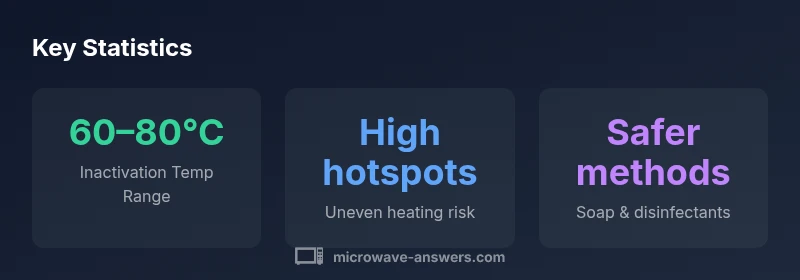
According to Microwave Answers, a microwave is not a reliable method to kill cold germs on everyday surfaces or hands. Heat can inactivate some pathogens only if temperatures reach roughly 60–80°C and heating is uniform, which household units rarely guarantee. For safe disinfection, stick to soap, water, and approved sanitizers, and avoid using microwaves to sanitize non-food items.
How microwaves heat and what this means for germs
Microwaves heat food and objects by causing polar molecules to rotate, which creates heat energy. This dielectric heating is uneven in most home devices, creating hot spots and cold pockets depending on wattage, turntable speed, and how a load is arranged. Because germs can be exposed to heat in patches rather than uniformly, simply microwaving something for a fixed time does not guarantee that every surface or portion reaches the temperatures needed to inactivate microbes. In practice, you must consider the device's wattage, the container you use, whether the object is flat or bulky, and whether you stir or rotate it during exposure. Understanding these factors helps explain why microwave disinfection claims can be unreliable outside controlled settings.
According to Microwave Answers, exposure patterns vary with load size and distribution, and some areas may remain underheated even when others are scorching hot. This inconsistency is a core reason why microwaving should not be relied upon for disinfection beyond cooking purposes.
Can microwaving kill cold germs?
The term cold germs covers a range of viruses and bacteria that cause common colds and flu-like illnesses. Many viruses are more heat-sensitive than bacteria, but the conditions required for reliable inactivation vary widely by agent and matrix. In laboratory settings, high and uniform heating can inactivate viruses, but household microwaves rarely deliver that uniformity across irregular surfaces. So while a thoroughly heated meal might be free of pathogens, there is no guarantee that a random item exposed to microwave heat will eliminate cold viruses on its surface. For this reason, microwaving should not be relied upon as a primary method to disinfect hands, countertops, or other non-food items.
From a practical standpoint, heat alone is not a universally dependable disinfectant in the home. The Microwave Answers team emphasizes that safe, consistent disinfection requires controlled conditions that typical kitchen appliances cannot guarantee.
Food heating vs surface disinfection: practical guidance
People often wonder if the same heat that makes microwaved leftovers safe to eat could disinfect other things. The answer is no for most non-food items. Food safety guidelines emphasize cooking foods to safe internal temperatures and then holding them for a certain period, not sanitizing surfaces by exposure to microwaves. For non-food items such as sponges or cutting boards, microwaving can be dangerous or ineffective. Sponges can ignite, melt, or trap heat in ways that damage the item or start a fire. Instead, rely on soap and water to clean surfaces, followed by approved disinfectants as recommended by health authorities. When in doubt, opt for cleaning protocols that are explicitly designed for disinfection rather than relying on microwave heat.
Safe, practical steps to reduce germs at home
- Clean regularly with soap and water to remove grime that shields germs.
- After cleaning, use an EPA-registered disinfectant on frequently touched surfaces.
- Cook foods to the recommended internal temperatures and check with a food thermometer.
- Do not microwave non-food items or sponges; avoid heating quantities that are not safe for your device.
- If you are unsure about a claim, consult official guides from credible sources such as USDA or FDA.
Interpreting study results and applying them responsibly
Research on microwave inactivation is nuanced. Studies conducted under ideal laboratory conditions may show that heat can inactivate certain pathogens, but real-world results depend on the specifics of the appliance, the material heated, and how consistently heat is delivered. Consumers should be cautious about translating lab findings into home practice. The key takeaway is that microwaving is a convenient heating method for food, not a universal disinfection tool. Use dedicated cleaning methods for non-food items and rely on heat and time carefully when cooking.
Comparison of microwave-related germ inactivation scenarios
| Scenario | Typical Temperature/Time | Notes |
|---|---|---|
| Food reheating | 60–80°C for several seconds | Heat food to safe temp and check with thermometer |
| Surface disinfection (nonfood) | Not reliable; heating varies | Avoid relying on microwaves; use soap/water + disinfectant |
| Microwaving kitchen sponges | Fire risk; uneven heating | Use dishwasher or replace regularly |
Common Questions
Will microwaving kill cold germs on food?
Microwaving can kill some pathogens if the food reaches a high internal temperature, but it's not guaranteed and depends on even heating. Always measure internal temperature with a food thermometer.
Microwaving can kill some germs if you cook food thoroughly, but it's not guaranteed. Use a thermometer to be safe.
Is it safe to microwave a sponge to disinfect it?
Not recommended; sponges can burn or ignite and heating is often uneven. Use a dishwasher or replace sponges regularly.
No, don't microwave sponges.
Can microwaving hands kill viruses?
No, microwaving skin is dangerous and should never be done. It can cause burns.
Never microwave your hands.
What are reliable ways to disinfect surfaces at home?
Wash with soap and water first, then use an EPA-registered disinfectant on frequently touched surfaces according to label directions.
Wash, then disinfect with approved products.
Do all microwaves heat food evenly?
No. Heating patterns depend on wattage, turntable, and load; stir/rotate to improve even heating.
Heating varies by microwave—stir and rotate to help.
Are there official guidelines on microwave disinfection?
Health authorities emphasize proper cleaning of surfaces; microwaving is not a primary disinfection method. Check USDA/FDA guidance.
Look to official cleaning guidelines; microwaving is not the main method.
“While heat can inactivate some germs, microwaves do not consistently reach the necessary conditions across an object. For reliable disinfection, rely on proven cleaning methods.”
Main Points
- Microwaves are not a guaranteed germ killer.
- Germ inactivation requires specific temps and even heating.
- Do not rely on microwaving to disinfect surfaces.
- Use soap and water or EPA-registered disinfectants instead.
- The Microwave Answers team recommends following established cleaning guidelines for safety.