Are X-Rays Longer Than Microwaves? A Wavelength Comparison
Explore whether X-rays are longer than microwaves by comparing wavelengths, photon energy, and practical uses. An analytical, data-backed guide from Microwave Answers.


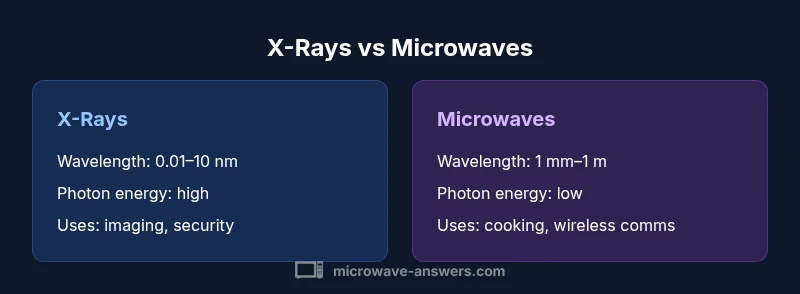
No. X-rays have substantially shorter wavelengths than microwaves, not longer. In the electromagnetic spectrum, X-ray wavelengths are roughly 0.01 to 10 nanometers, while microwaves span about 1 millimeter to 1 meter. This difference affects how each type interacts with matter, imaging methods, and safety considerations. Practically, you encounter X-rays in medical imaging and security screening, and microwaves in cooking and wireless communications.
Are X-Rays Longer Than Microwaves? What the numbers say
Many readers ask: are x rays longer than microwaves? The short answer is no. X-rays occupy the short-wavelength end of the electromagnetic spectrum, while microwaves sit at a much longer end. This simple fact has profound implications for energy per photon, interaction with matter, and safety considerations. In this context, are x rays longer than microwaves is a misleading way to frame the comparison: wavelength matters far more for predicting behavior than the coarse label of the frequency band.
X-ray wavelengths are typically cited as roughly 0.01 to 10 nanometers, while microwaves range from about 1 millimeter to 1 meter. When you convert between wavelength and energy, you see that X-ray photons carry far more energy per photon than microwaves. The practical upshot is that X-rays are more penetrating and ionizing, whereas microwaves are primarily associated with heating and signaling. This paragraph sets the stage for a deeper look into spectrum structure, photon energy, and context.
Comparison
| Feature | X-rays | Microwaves |
|---|---|---|
| Wavelength range | ~0.01–10 nanometers | ~1 millimeter–1 meter |
| Frequency range | ~3×10^16–3×10^19 Hz | ~3×10^8–3×10^11 Hz |
| Photon energy (per photon) | High-energy photons | Low-energy photons |
| Common uses | Medical imaging, security screening | Cooking, wireless communications |
| Penetration and interaction with matter | High penetration; ionizing in many materials | Less penetrating; heating and signaling dominant |
Advantages
- Clarifies the core difference in wavelength, energy, and interaction
- Helps readers avoid common misconceptions about the names of the bands
- Supports practical decision-making across safety and usage contexts
- Bridges physics concepts to everyday applications
Cons
- Requires some physics background to fully interpret wavelength-energy links
- Ranges are approximate and context-dependent
- Potential for oversimplification if filters aren’t specified (e.g., imaging vs therapy)
X-rays do not have longer wavelengths than microwaves; microwaves occupy a longer-wavelength region of the spectrum, while X-rays are much shorter and more energetic.
In practical terms, wavelength is the primary differentiator. Microwave wavelengths sit at the longer end of the spectrum, while X-ray wavelengths are at the opposite, much shorter end. This distinction drives applications, safety concerns, and how each type interacts with matter.
Common Questions
Are X-rays longer than microwaves?
No. X-rays have much shorter wavelengths than microwaves. This results in higher photon energy and different interactions with matter.
No—X-rays are shorter in wavelength and more energetic than microwaves; they interact with matter differently and have distinct safety considerations.
What is the typical wavelength range for X-rays?
X-ray wavelengths are commonly cited as about 0.01 to 10 nanometers, placing them at the short-wavelength end of the spectrum.
X-rays range roughly from a hundredth to ten nanometers in wavelength.
What is the typical wavelength range for microwaves?
Microwaves span approximately 1 millimeter to 1 meter in wavelength, which is much longer than X-rays.
Microwaves cover roughly a millimeter up to a meter in wavelength.
Are microwaves safe for everyday use?
Yes, within device specifications and regulatory limits, microwaves are non-ionizing and primarily heat materials containing water.
In ordinary use, consumer microwaves are generally safe when used as directed.
Can X-rays be used for cooking or food processing?
X-rays are not used for cooking in consumer kitchens; they are mainly used for imaging or irradiation in controlled industrial settings, with strict safety protocols.
X-rays aren’t used for cooking. They’re used mainly for imaging or controlled processing in safe environments.
Do all EM waves heat matter the same way?
No. Microwaves deposit energy efficiently in water-containing materials (heating), while X-rays interact mostly through ionization and scattering, not heating in typical exposures.
Not all EM waves heat things the same way; microwaves heat, X-rays ionize and scatter.
Main Points
- Compare wavelengths first, not labels, when evaluating EM radiation
- X-rays have shorter wavelengths and higher photon energy than microwaves
- Microwaves are longer-wavelength and primarily associated with heating and signaling
- Safety profiles differ dramatically: X-rays are ionizing; microwaves are non-ionizing at typical consumer exposures
- Use this wavelength-focused framework to interpret real-world claims about the spectrum