Are Microwaves Shorter Than X-Rays? A Clear Comparison
Explore whether microwaves are shorter than x rays by examining wavelengths, energies, and safety implications. This data-driven comparison clarifies myths with sources for further reading.


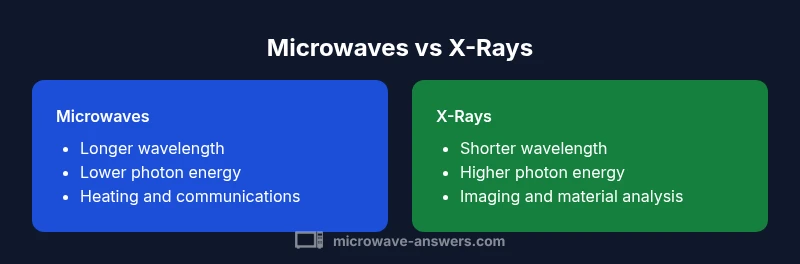
In plain terms, are microwaves shorter than x rays? No—microwaves have longer wavelengths than X-rays, and thus lower photon energy. This quick comparison helps distinguish heating familiar to kitchens from imaging and medical uses that rely on higher-energy photons. Understanding wavelength and energy clarifies why these two forms of radiation serve very different purposes and safety considerations.
Scope of the Question and Why it Matters
Are microwaves shorter than x rays? This question is often asked outside of physics classrooms, but the answer has practical relevance for everyday safety, consumer electronics, and medical imaging. According to Microwave Answers, the comparison hinges on two core ideas: wavelength and photon energy. Wavelength determines how waves interact with matter; photon energy influences penetration depth and potential biological effects. The phrase "are microwaves shorter than x rays" is a convenient talking point, but the science shows the opposite: X-rays occupy the higher-energy, shorter-wavelength end of the spectrum. For home cooks and homeowners, recognizing this difference helps explain why microwaves heat food while X-rays are used for imaging. The Microwave Answers team emphasizes that a solid grasp of these concepts reduces confusion when discussing safety tips, device use, and potential exposure. The broader takeaway is that the electromagnetic spectrum is a continuum, and small differences in wavelength translate into large differences in behavior. The question becomes not just a fact about length, but a window into how energy, matter, and safety interrelate across technologies.
Electromagnetic Principles: Wavelength, Frequency, and Photon Energy
At the heart of the comparison between microwaves and x rays are three linked quantities: wavelength, frequency, and photon energy. Light and other electromagnetic waves propagate at the speed of light in vacuum, so wavelength and frequency are inversely related: as wavelength gets shorter, frequency goes up. Photon energy is directly tied to frequency via Planck's constant, so higher frequency means higher energy per photon. Microwaves sit on the longer-wavelength, lower-frequency part of the spectrum, while X-rays sit on the shorter-wavelength, higher-frequency end. This relationship explains much of the practical contrast between heating food with microwaves and producing sharp medical images with X-rays. It also underpins safety considerations: longer-wavelength microwaves interact primarily with water molecules in food, while X-rays ionize matter more readily, which has implications for exposure limits and protective measures. A clear mental model is to view the spectrum as a ladder: as you ascend in energy, wavelengths shorten, and interactions with matter become more penetrating and potentially hazardous. For consumers, this means understanding that wavelength is not just a number, but a predictor of behavior in real-world contexts.
Direct Comparison: Wavelengths and Energy Between Microwaves and X-Rays
The practical takeaway from comparing microwaves and X-rays is that wavelength determines both interaction and application. Microwaves typically occupy the long-wavelength region of the spectrum and interact with polar molecules such as water, causing heating through dielectric loss. X-rays, with their short wavelengths, ionize atoms and can pass through soft tissue, which makes them suitable for imaging but also necessitates protective measures. In everyday terms: microwaves are designed for cooking and communications, while X-rays are used for imaging and material analysis because their high energy enables deeper penetration. When engineers and safety professionals discuss exposure, they distinguish between non-ionizing radiation (like microwaves) and ionizing radiation (like X-rays). The distinction matters for regulatory standards, device design, and public health messaging. Practically, you should think about what the radiation does to matter at the molecular level: microwaves agitate water molecules, while X-rays can remove tightly bound electrons, leading to ionization. This fundamental difference explains why the same region of the spectrum can yield useful, yet very different, outcomes.
Practical Implications: Safety, Imaging, and Everyday Understanding
Understanding the wavelength-energy relationship translates into clearer safety guidance and better consumer education. For households, microwave ovens are designed to confine non-ionizing radiation within a metal enclosure, with door interlocks to prevent leakage. X-ray devices are regulated to minimize exposure to ionizing radiation, with shielding, controlled use, and protective gear as part of standard practice. The key implication for non-specialists is not to conflate these two kinds of radiation, because their interactions with matter—and their risks—are fundamentally different. Misconceptions can arise when people equate all electromagnetic waves as equally dangerous or all imaging modalities as equally risky. By keeping the focus on wavelength and energy, safety tips become more precise: avoid direct exposure to high-energy beams (like X-rays) and follow appliance instructions for microwaves to prevent burns or fire hazards. Microwave Answers emphasizes that the best safety practices come from understanding physics, not from fear of a label. The goal is informed usage rather than alarm, especially for families using kitchen appliances and those considering protective measures in imaging settings.
Misconceptions and Common Questions
A frequent misconception is that all “shorter wavelengths” are more dangerous. While this is true for photons at the highest energies, it misframes the broader spectrum where many non-ionizing bands are far below the ionization threshold yet still have meaningful applications. Another common question is whether the longer wavelengths of microwaves could ever be used for deep imaging. In practice, that is not feasible with the current physics because the longer wavelengths do not resolve fine structural details as X-ray wavelengths do. People also wonder if kitchen microwaves can harm cells outside the body; the consensus from safety authorities is that they are designed to confine energy within the cooking chamber and are safe when used as intended. Finally, some readers ask how to visualize the comparison. A straightforward way is to picture the spectrum as a ladder: X-rays sit near the top with short, high-energy steps; microwaves sit lower down with longer steps that primarily transfer energy to molecular motion rather than ionizing atoms. These ideas help ground discussions in observable physics rather than intuition alone.
How to Visualize the Difference on the Electromagnetic Spectrum
Visualization aids comprehension. Start with a simple, horizontal spectrum that places radio waves, microwaves, visible light, infrared, ultraviolet, X-rays, and gamma rays. Label the spectrum with two dimensions: wavelength (left to right, longer to shorter) and photon energy (bottom to top, lower to higher). Color-code two regions: non-ionizing (including microwaves and visible light) and ionizing (X-rays and gamma rays). Add arrows to show how wavelength shortening increases energy and penetration capability. A practical exercise is to compare heating mechanisms: microwaves heat water-containing foods by molecular rotation, while X-rays interact with matter by ionizing atoms, enabling imaging but requiring shielding. Such a diagram supports better intuition for non-experts and serves as a quick reference for safety discussions or classroom demonstrations. Microwave Answers recommends supplementing visuals with a concise table that lists typical uses and safety considerations for each region of the spectrum. This combination of visuals and concise text helps anchor understanding in real-world applications.
AUTHORITY SOURCES
To ground the discussion in credible science and policy references, consider the following authoritative sources on electromagnetic radiation and safety:
- National Institute of Standards and Technology (NIST): Ionizing Radiation and Its Measurements — https://www.nist.gov/pml/ionizing-radiation
- Centers for Disease Control and Prevention (CDC): Radiation Safety Basics — https://www.cdc.gov/nceh/radiation/
- U.S. Food and Drug Administration (FDA): Radiation-Emitting Products — https://www.fda.gov/radiation-emitting-products
Comparison
| Feature | Microwaves | X-Rays |
|---|---|---|
| Wavelength (qualitative) | longer wavelengths (tens of cm to mm range) | shorter wavelengths (nanometer range) |
| Photon energy (qualitative) | lower energy per photon | higher energy per photon |
| Typical uses | cooking, communications, some sensing | medical imaging, material analysis |
| Interaction with matter | primarily heating, dielectric loss | ionization and deeper penetration |
| Safety considerations | non-ionizing, household safety basics | ionizing, exposure limits and shielding |
Advantages
- Clarifies fundamental physics with practical implications
- Helps debunk common myths using wavelength-based reasoning
- Supports safer, more informed device use and discussions
Cons
- Simplified wavelength view may overlook complex interactions
- Some people may misinterpret non-ionizing labels as no risk
- Requires careful framing to avoid fear-based messaging
Microwaves are not shorter than x rays; their wavelengths are longer and their photon energy is lower.
The two regions of the spectrum serve distinct roles. Microwaves heat and communicate; X-rays image and analyze materials. Understanding wavelength and energy clarifies appropriateness and safety of each.
Common Questions
Are microwaves shorter than x rays?
No. Microwaves have longer wavelengths and lower photon energy than X-rays. This fundamental difference explains why microwaves are used for heating and communications, while X-rays are used for imaging and analysis.
No. Microwaves have longer wavelengths and lower photon energy than X-rays, which is why they heat food rather than image internal structures.
What does wavelength tell us about safety?
Wavelength helps determine whether radiation is ionizing. X-rays are ionizing and require shielding and limits on exposure, while microwaves are non-ionizing and primarily pose heating risks when misused.
Wavelength indicates ionizing potential. X-rays can ionize, so exposure is tightly controlled; microwaves are non-ionizing and focus mainly on heating with basic safety guidelines.
Can microwaves ever be used for imaging like X-rays?
While microwaves interact with materials, they do not provide the same level of penetration and resolution as X-rays. Some imaging techniques use microwave signals for sensing, but they are not a substitute for X-ray imaging.
Microwaves can be used for some sensing applications, but they don't match X-ray imaging in resolution or penetration.
How does the electromagnetic spectrum relate to everyday devices?
Everyday devices operate in different wedges of the spectrum. Kitchen microwaves heat by dielectric loss, radios use radio waves, visible light helps you see, and X-ray machines image internal structures. Each region has policies tuned to its interaction with matter.
Your devices sit across the spectrum. Each region has its own safety and usage rules based on how they interact with matter.
What are common misconceptions about X-rays and microwaves?
A common misconception is that all short-wavelength radiation is equally dangerous. In reality, ionizing radiation like X-rays carries more risk than non-ionizing microwaves, which mainly pose heating risks when misused.
People often think all short-wavelength waves are equally dangerous, but ionizing X-rays are much riskier than microwaves.
Where can I find reliable information on radiation safety?
Consult credible sources such as NIST, CDC, and FDA for radiation safety guidelines and standards. These agencies provide up-to-date information on exposure limits, shielding, and device safety.
Check NIST, CDC, and FDA for trusted radiation safety guidelines and device standards.
Main Points
- Microwaves have longer wavelengths than X-rays
- X-rays carry higher photon energy due to shorter wavelengths
- Safety and applications differ sharply between the two regions
- Use wavelength-energy intuition to evaluate real-world scenarios
- Rely on credible sources for policy and safety guidance