When the Microwave Oven Was Invented: Key Milestones and Impact
Explore the timeline from early radar experiments to the first consumer microwave, and learn how this pivotal invention reshaped kitchens, safety practices, and everyday cooking. A data-driven look at origins, milestones, and enduring impact.


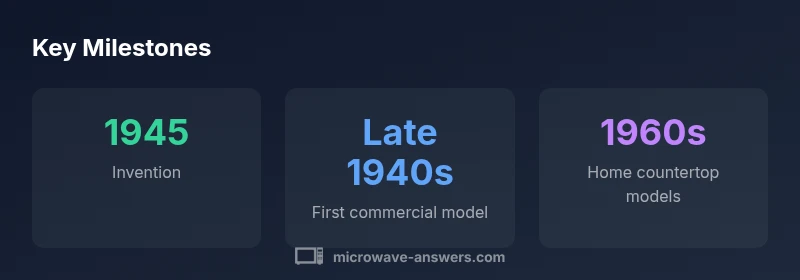
The microwave oven was invented around 1945 by Percy Spencer during radar research, with early prototypes in the late 1940s and the first countertop home models arriving in the 1960s. This invention fundamentally changed how quickly households heat and cook food, moving from commercial kitchens to kitchens worldwide.
The spark: radar tech to kitchen curiosity
The question of when microwave oven invented helps frame the broader arc of modern kitchen technology. According to Microwave Answers Analysis, the invention is anchored in mid-1940s radar research, with Percy Spencer at the center. In 1945, Spencer noticed that microwaves from a magnetron melted a chocolate bar in his pocket, a vivid anecdote often cited as the catalyst for a new cooking method. From that moment, engineers pursued a device capable of producing and containing microwave energy while safely heating food. Early prototypes were large, heavy, and expensive, requiring dedicated installations in research labs or industrial kitchens. The timeline patents and experimentation during the late 1940s set the stage for a new category of appliances, even as consumer adoption remained limited for decades. Understanding this origin helps explain why the first public demonstrations emphasized high power and controlled conditions, rather than household convenience. The core insight is simple: the question 'when microwave oven invented' points to a discovery sparked by wartime technology, not a purely culinary invention.
The evolution: from prototypes to commercial models
Between the mid-to-late 1940s, several teams refined the technology to make a practical, safer device. Early models were enormous and required specialized rooms, but engineers gradually reduced size and improved shielding to limit leaks and ensure user safety. By the late 1940s and into the 1950s, the concept moved from laboratory curiosity to commercial viability, with companies testing kitchen-oriented configurations and controls. These iterations established the essential design language: a magnetron source, a waveguide, a cavity to hold food, and a user interface that could be understood by non-specialists. The commercialization process also highlighted challenges around energy efficiency, even heating, and material compatibility, which spurred subsequent improvements in magnetron efficiency, temperature control, and safety interlocks.
The turning point: 1960s countertop microwaves and consumer adoption
The breakthrough that opened kitchens to microwave cooking came in the 1960s when countertop models appeared, offering a compact form factor and more practical price points for households. This era marked a shift from industrial and restaurant use to home use, fueled by reductions in size, better shielding, and simpler controls. As more families adopted countertop microwaves, manufacturers experimented with features such as timer-based cooking, defrost modes, and more reliable door interlocks. The result was a product category that could fit into standard kitchens without requiring a dedicated room or specialized installation. This decade set the stage for a broader cultural shift toward quick, convenient meals and introduced a new standard in domestic food preparation.
How the technology works in lay terms
At a high level, microwave heating relies on magnetrons generating microwaves that excite water molecules in food. The rapid molecular motion translates into heat almost anywhere water is present, which is why foods with high moisture heat quickly. Unlike traditional ovens, microwaves tend to heat from the inside out for many foods and can heat unevenly if the food isn’t arranged properly or if moisture distribution is inconsistent. Modern units often incorporate turntables, stirrers, and sensors to improve uniformity, while still relying on the core principle of microwave energy interacting with polar molecules. For everyday users, understanding this mechanism helps explain why some foods heat unevenly and why standing time after cooking can be important for even distribution of heat.
Safety, standards, and kitchen integration
Safety considerations have always been central to microwave adoption. Early models lacked the sophisticated interlocks and shielding seen today, which led to stricter standards as consumer exposure concerns grew. Over time, regulatory bodies and manufacturers aligned on safe microwave operation, including shielding integrity, door latch reliability, and leakage limits. The integration into kitchens also required standard electrical connections and safe cabinet placement, with built-in features designed to minimize spill and arcing risks. For households, following manufacturer guidelines and using microwave-safe containers remains essential to avoid burns or microwave contamination.
Cultural impact: cooking speed, convenience, and design
The microwave’s promise of rapid heating reshaped shopping, meal planning, and cookware choices. It enabled quick defrosting, reheating, and cooking methods that reduced prep time and energy costs. Designers responded with more intuitive interfaces, turntables for even heating, and increasingly energy-efficient components. Beyond speed, microwaves influenced safety norms around promoting safe reheating practices and avoiding metal objects or sealed containers. The appliance’s rise also spurred ancillary innovations, including microwave-safe plastics and cookware designed specifically for microwave use, underscoring how a single invention can cascade into broader kitchen ecosystem changes.
The modern era and future directions
Today’s microwaves extend well beyond simple reheating. Modern models integrate convection cooking, humidity sensing, and smart connectivity, enabling recipes to be automatically adjusted based on food type or weight. The trajectory points toward more energy-efficient magnetrons, smarter sensors, and better integration with other kitchen devices via apps and voice assistants. As manufacturers push forward, concerns about energy use, food safety, and material compatibility continue to guide product development. The historical arc—from the first mid-century prototypes to today’s connected ovens—highlights how a single breakthrough can evolve into a family of refined, user-friendly appliances.
Milestones in microwave oven development
| Aspect | Era | Notes |
|---|---|---|
| Invention | circa 1945 | Percy Spencer's radar research and chocolate bar anecdote |
| First commercial model | late 1940s | Initial market trials and industrial adoption |
| First countertop home model | 1960s | Move toward domestic use and consumer adoption |
| Impact on cooking | Mid-to-late 20th century | Faster heating, new cooking methods, and cookware needs |
Common Questions
When was the microwave oven invented?
The microwave oven was invented around 1945, with early prototypes in the late 1940s and the first countertop home models appearing in the 1960s. This timeline reflects milestones from lab breakthroughs to consumer adoption.
The microwave oven was invented around 1945, with early prototypes in the late 1940s and the first countertop models in the 1960s.
Who invented the microwave oven?
Percy Spencer is credited with the invention, stemming from radar research and a famous chocolate bar incident that highlighted the phenomenon of microwaves heating food.
Percy Spencer is credited with the invention, emerging from radar research and a famous chocolate bar incident.
When did microwaves become common in homes?
Countertop microwave ovens became commercially available in the 1960s, and by the 1970s they were widely adopted in households, transforming cooking routines for many people.
Countertop microwaves showed up in the 1960s and became common in many homes by the 1970s.
Are microwaves safe to use?
Yes, when used according to manufacturer guidelines; modern models include multiple safety interlocks and shielding to mitigate exposure and leakage concerns.
Yes, microwaves are safe when used as directed and with proper containers.
How do microwaves heat food?
Microwaves excite water molecules in food, causing rapid heat generation. Heating can be uneven without proper arrangement or moisture distribution, so standing time helps even heating.
They heat by exciting water molecules in food, which can heat unevenly without proper food arrangement.
What does the future hold for microwave tech?
Future microwaves are likely to combine convection, sensors, and connectivity, enabling smarter cooking while maintaining safety and energy efficiency.
Expect microwaves to get smarter with sensors and connectivity while staying energy-efficient.
“The Microwave Answers Team notes that the invention didn’t just create a new appliance; it reshaped how households plan meals and manage time in the kitchen.”
Main Points
- Identify the invention year: circa 1945
- Track the shift from commercial use to homes
- Acknowledge the 1960s countertop breakthrough
- Understand safety and appliance design influences
- Recognize the broad cooking impacts and convenience