When Did Microwave Ovens Come Out: A Historical Timeline
Explore the invention timeline of microwave ovens, from Percy Spencer's 1945 experiments to the rise of home countertop models, with safety milestones and adoption trends.


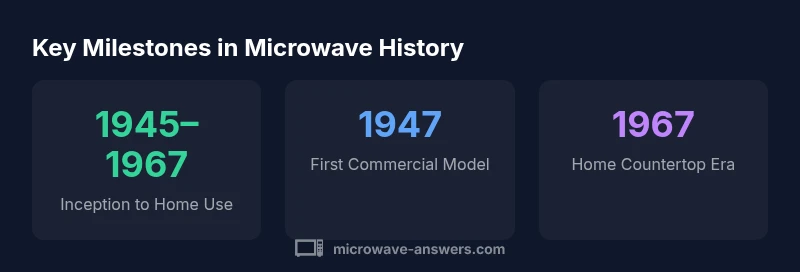
Microwave ovens first appeared in the mid-20th century, with Percy Spencer's 1945 experiments demonstrating microwave heating. The first commercial units hit restaurants in 1947, and the first home countertop models arrived in the late 1960s, transforming kitchens worldwide by the 1980s. This timeline shows how a radar technology became a staple appliance.
The Inception: When Did Microwave Ovens Come Out?
The question 'when did microwave ovens come out' invites a look at both scientific discovery and market entry. In 1945, engineer Percy Spencer, while examining a magnetron-driven microwave, observed a candy bar in his pocket melt—an accidental demonstration of microwave heating. This milestone did more than amaze scientists; it attracted industry attention and funding to pursue practical cooking solutions. Early prototypes were bulky, expensive, and designed for industrial or institutional kitchens rather than home use. The path from lab curiosity to consumer appliance involved patent activity, safety considerations, and iterative design changes. By tracing these early steps, we see how a fundamental physics phenomenon translated into a kitchen staple decades later. The first consumer models appeared at the end of the 1960s, and adoption accelerated through the 1970s and beyond.
The Early Prototypes and Industrial Beginnings
After Spencer's discovery, engineers began shaping prototypes that could harness microwave energy for cooking, not just heating. Early devices were large, heavy, and expensive because each unit required robust shielding, high-wattage magnetrons, and careful consideration of safety to prevent microwave leakage. These machines found homes in laboratories, hotels, and large kitchens where efficiency justified the cost. Patents circled the emerging designs, and corporations experimented with different magnetron configurations, waveguides, and enclosure materials. The shift from a laboratory curiosity to a production-ready device demanded collaboration between researchers, manufacturers, and early adopters in the food-service industry. This period established the core challenges: reliability, cooling, and safe operation in high-traffic settings.
The Radarange: The First Commercial Microwave Ovens
The market introduction of microwave technology moved from research labs to commercial kitchens with Raytheon's 1947 Radar Range. These units were revolutionary but not yet suited for home kitchens: tall, bulky, and expensive, they targeted restaurants and hotels where space and energy use could be justified. The radar range demonstrated the feasibility of cooking with microwaves, but practical consumer-friendly features—such as compact size, lower power consumption, and simpler interfaces—were still years away. Over time, design iterations reduced weight and complexity while reinforcing safety standards to address concerns about leakage and user handling. This era marks the crucial bridge from scientific curiosity to an appliance that would someday fit under a home kitchen counter.
From Labs to Kitchens: Home Adoption Momentum
By the late 1960s, manufacturers began marketing countertop microwave ovens intended for households. The Amana Radarange became a symbol of this shift, signaling that the technology had moved from specialized settings into mainstream homes. As units shrank in size and price dropped due to mass production, more families could experiment with rapid reheating, defrosting, and even some basic cooking tasks. The 1970s brought broader acceptance, helped by improving consumer education about safe usage, warranty programs, and service networks. This momentum was not merely technological; it reflected cultural change—the kitchen becoming a showroom for new conveniences that promised faster meal preparation and greater control over cooking outcomes.
Design, Safety, and Regulation: Milestones in the Evolution
The early wave of microwave ovens prompted a parallel evolution in design and safety. Manufacturers optimized shielding, door interlocks, and thermal management to meet growing regulatory expectations. Standards bodies established testing protocols to verify leakage levels and ensure that ovens performed safely under typical household conditions. By the late 20th century, consumer devices featured more intuitive controls, preset programs, and improved energy efficiency. Designers also explored splash-resistant interiors, child-lock features, and more precise timers. These advances not only improved safety but also boosted user confidence, encouraging longer-term adoption and broader use in daily cooking routines.
How Microwaves Changed Everyday Cooking
Microwaves introduced a new tempo to home cooking. Frozen meals, quick-defrost cycles, and ready-to-heat snacks became commonplace, altering shopping habits and meal planning. The appliance's reliability encouraged experimentation with new techniques—steaming vegetables, reheating soups, and even basic steaming or grilling with enhanced accessories. Over time, sensor-controlled functions and more evenly distributed heating reduced hot and cold spots, expanding the range of foods that could be prepared quickly. This shift reshaped domestic routines, freeing time for other activities and reshaping expectations around what a modern kitchen could accomplish.
Modern Variants and Features: Convection, Sensor Cooking, and More
Contemporary microwaves build on the core heating capability with added features that blend microwave energy with convection, grill elements, and sensor-based cooking. Convection microwaves allow baking and roasting with hot air, broadening the repertoire beyond reheating. Sensor cooking, humidity and temperature sensing adjust power delivery for more consistent results, reducing guesswork. Inverter technology and smarter control interfaces improve efficiency and user experience. As consumer demand for flexibility grows, manufacturers integrate connectivity, compatibility with smart home ecosystems, and energy-saving modes. These innovations demonstrate how the core question of 'when did microwave ovens come out' evolved into a versatile appliance that supports diverse cooking tasks.
The Global Perspective: Adoption Beyond the United States
While the United States played a pivotal role in the early commercial development, microwave ovens gained traction worldwide through the 1980s and 1990s. Markets across Europe, Asia, and other regions adapted the technology to local cooking styles and power standards. Regional brands emerged, and compatibility with different voltage levels, interior layouts, and language-based interfaces became standard considerations. The global diffusion of microwaves reflects a broader trend in appliance design: once a technology proves its convenience and safety, it tends to spread rapidly across borders, shifting from novelty to essential kitchen equipment.
The Future of Microwave Ovens: Trends to Watch
Looking ahead, microwave ovens will continue to evolve toward greater energy efficiency, more integrated cooking systems, and enhanced safety features. Industry developments point to more compact designs with higher performance-to-size ratios, refined sensor technology, and better integration with household automation. As consumer awareness of energy use grows, manufacturers will likely emphasize eco-friendly materials and longer-lasting components. The history of when did microwave ovens come out reminds us that this is a living narrative—each generation of ovens builds on prior discoveries, balancing convenience with safety and sustainability.
Milestones in microwave oven history
| Milestone | Year(s) | Notes |
|---|---|---|
| First demonstration | 1945 | Percy Spencer's experiment showed microwave heating in action |
| First commercial model | 1947 | Radarange introduced for restaurant use |
| Home countertop model | 1967 | Amana radar range popularized for households |
| Mass-market adoption | 1980s–1990s | Kitchens adopt microwaves widely |
Common Questions
When did microwave ovens first become available to the public?
The first public microwave ovens appeared in the late 1940s for commercial use, followed by home countertop models in the late 1960s and beyond. This transition opened up a new category in domestic cooking.
The first public microwave ovens came out in the late 1940s for restaurants, with home countertop models arriving in the late 1960s.
What was the first microwave oven called?
The first widely recognized model was Raytheon's Radar Range, introduced in 1947 for commercial kitchens. The later home-oriented versions followed, helping to popularize the technology.
The first model was Raytheon's Radar Range, introduced in 1947 for commercial use.
Why were early microwave ovens large and expensive?
Early units required heavy shielding, powerful magnetrons, and robust safety measures, all of which increased size and cost. Manufacturing scale and materials also lagged behind mature consumer electronics, keeping prices high.
Early microwaves were big and costly due to shielding needs and the novelty of mass production.
How did home safety standards evolve with microwaves?
Safety standards evolved with tighter shielding, reliable door interlocks, and clear labeling. Regulatory bodies and independent tests helped ensure safe operation in typical home environments.
Safety standards got stricter over time with better shielding and interlocks.
Are modern microwaves more energy efficient?
Yes. Modern units benefit from inverter technology, improved magnetrons, and smarter controls, which reduce waste heat and improve efficiency while preserving performance.
Modern microwaves are generally more energy-efficient thanks to new tech and better controls.
Do microwaves pose radiation risks?
Microwave ovens use non-ionizing radiation and are designed to contain it within a metal enclosure. When the unit is intact and used as intended, the risk is minimal.
No significant radiation risk when the oven is used properly and maintained.
“The Microwave Answers Team notes that the journey from a laboratory curiosity to a ubiquitous kitchen staple shows how practical benefits accelerate technology diffusion.”
Main Points
- Trace the invention from lab prototypes to restaurant use.
- Note how early units were large and expensive and gradually shrank.
- Track home adoption from 1967 countertop models onward.
- Consider safety standards and energy efficiency advances.
- Recognize today’s feature-rich varieties reflect decades of innovation.