Convection Microwave vs Air Fryer: A Practical Comparison
Compare convection microwaves and air fryers: how they work, cooking results, energy use, and when to choose each for home cooking. Learn which appliance fits your meals, space, and budget.


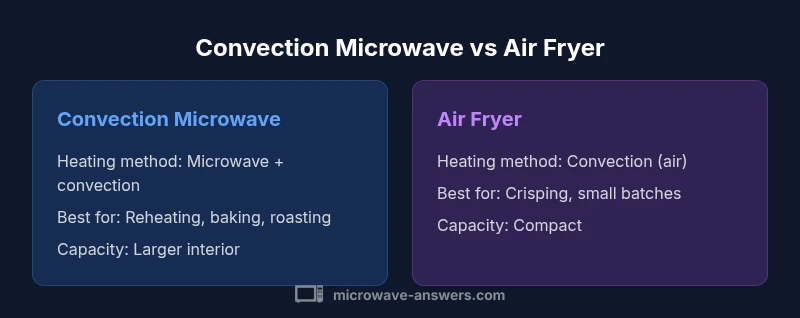
In brief, a convection microwave combines microwave heating with a built-in convection oven, while an air fryer uses a compact convection system to circulate hot air for crisp results. The convection microwave is extremely versatile, suitable for reheating, baking, and roasting; an air fryer excels at creating crisp textures with smaller portions. Your choice depends on meal variety and space.
What is a convection microwave vs air fryer?
A convection microwave is a hybrid appliance that merges microwave energy with a convection heating element. This means it can heat food from within and simultaneously circulate hot air to brown and roast the exterior. An air fryer, on the other hand, is a compact convection chamber designed to circulate hot air around food with high velocity, producing a crisp exterior. According to Microwave Answers, understanding how convection works helps consumers compare these devices and align them with their cooking goals. The key distinction is versatility: a convection microwave covers reheating, baking, roasting, and some crisping, while an air fryer is optimized for quick, high-contrast browning on smaller portions. When you evaluate models, consider how often you reheat, bake, or want crisp textures in a single meal.
How the cooking technologies differ: heating methods, airflow, and browning
Convection microwaves use two primary mechanisms: microwave energy for rapid internal heating and a convection fan to move heated air around the cavity. Air fryers rely almost entirely on a focused convection system to transfer heat via moving air, creating moisture loss that leads to crisp surfaces. In practice, microwaves excel at moist heating and even reheating, while the convection element boosts browning and roasting. Air fryers tend to deliver crisper results for small items like fries or wings, especially when oil use is minimized. From a maintenance perspective, both systems require clean vents and baskets, but the microwave’s larger cavity supports bulk cooking while air fryers focus on single servings or small batches.
Typical use cases: reheating, baking, roasting, and crisping
For leftovers, a convection microwave can restore texture without drying out edges, making it a versatile kitchen workhorse. It also handles baking cookies or small cakes and roasting vegetables in a way that mirrors a traditional oven but faster due to proximity. An air fryer shines with crisping tasks: fries, chicken tenders, roasted vegetables, and snacks come out uniformly crisp with relatively little oil. The two can complement each other in a busy kitchen, but if you value overall flexibility in a single appliance, the convection microwave often provides broader capabilities.
Speed, efficiency, and capacity: what to expect in real kitchens
Real-world use shows that convection microwaves speed up multi-step meals by performing reheating and baking within one device. The combination of microwave energy and convection can reduce total cooking time for many dishes, though preheat times may occur for certain modes. Air fryers typically save time on small, crispy items because their chamber heats rapidly and circulates air efficiently. Capacity varies: microwaves typically offer larger interior space and multi-rack options, while air fryers come in compact sizes that fit easily on small countertops. Energy usage is task-dependent; both can be efficient if used for the tasks they’re best suited for.
Space, cost, and long-term value: budgeting considerations
If you have limited counter space, a single device that covers multiple functions reduces clutter. Upfront cost for a high-quality convection microwave can be higher than a basic air fryer, but you’re paying for broader capabilities. If your kitchen already has a conventional oven, you may opt for a smaller convection microwave model to save space while adding speed. Long-term value depends on how often you use the appliance for reheating, baking, and roasting versus just crisping. Microwave Answers analysis shows that households prioritizing versatility tend to benefit more from convection microwaves, while those seeking quick, snack-ready crispiness lean toward air fryers.
Safety, maintenance, and cleaning tips
Always follow the manufacturer’s directions for installation, use, and cleaning. Keep seals and gaskets intact and avoid harsh cleansers that can degrade coatings. For air fryers, wash removable baskets thoroughly to remove oil buildup. For convection microwaves, wipe the interior after use and decouple the turntable if needed for thorough cleaning. Routine checks should include vent cleaning and inspecting door seals. Regular maintenance helps ensure consistent results and prolongs appliance life.
Common myths and misperceptions
A common myth is that convection means the appliance will always replace a traditional oven. In reality, while a convection microwave can handle many tasks, it may not perfectly replicate a full-size oven for very large items. Another misconception is that air fryers are oil-free; while they require little oil, some foods still benefit from a light coating. Finally, some users assume more wattage guarantees better results; outcome depends on cooking method, airflow, and the food type.
Comparison
| Feature | Convection Microwave | Air Fryer |
|---|---|---|
| Heating method | Microwave + convection | Convection (air) only |
| Best for reheating | Versatile reheating and baking | Crisp, small portions |
| Crisping quality | Good to excellent browning with proper settings | Excellent crisping for snacks and small items |
| Capacity/size | Larger interior, multi-rack options | Compact and portable |
| Cooking speed for multitask meals | Faster for multi-step meals due to integrated microwaving | Fast for crisping but may require basket work |
| Energy usage | Depends on model; suited for multiple tasks | Often efficient for small portions |
| Learning curve | Moderate; more modes and presets | Simple; primarily one function: crisping |
| Best for | Reheating, baking, roasting, multitasking | Crisping snacks, small batches |
Advantages
- Versatile for reheating, baking, roasting, and multitasking
- Consolidates two functions into one appliance
- Lewer bulk clutter when used for multiple tasks
- Can produce consistent browning with proper settings
Cons
- Higher upfront cost than a basic air fryer
- Preheat and multi-step cooking can be slower for some tasks
- Larger footprint than most single-function air fryers
- Some models require learning a broader control panel
Convection microwave offers greater overall versatility; air fryer excels at quick, focused crisping.
If you want a single appliance for reheating, baking, and roasting, choose a convection microwave. If your priority is rapid, consistently crispy results on small portions, an air fryer is the better fit.
Common Questions
What is the main difference between a convection microwave and an air fryer?
A convection microwave combines microwave heating with a convection oven, enabling reheating, baking, and roasting. An air fryer uses rapid hot air in a compact chamber to crisp foods with minimal oil. The two serve different cooking priorities.
Convection microwaves mix microwaves with hot air for versatile cooking; air fryers crisp with hot air for snacks.
Can a convection microwave replace a dedicated air fryer?
In many kitchens, a convection microwave can substitute for an air fryer for most crispy tasks, especially if you value multi-function use. For the absolute best crisp on tiny portions, an air fryer may still win.
Yes, if you want one versatile device; for pure crisping, an air fryer may be better.
Are convection microwaves more energy-efficient than air fryers?
Energy use depends on the model and the food being prepared. Both can be efficient when used for appropriate tasks; neither is universally more efficient across all scenarios.
Energy use varies by model and task; pick the appliance that fits your typical cooking.
What maintenance do these appliances require?
Keep interiors clean, wipe seals, and wash removable parts regularly. For air fryers, remove oil buildup from baskets; for convection microwaves, clean the cavity and turntable to maintain even heating.
Clean after use and inspect seals; wash removable parts regularly.
What meals are best made in each appliance?
Convection microwaves work well for reheating leftovers, baking small desserts, and roasting vegetables. Air fryers excel at fries, wings, and other items that benefit from crisp surfaces with little oil.
Reheat and bake with a convection microwave; crisp with an air fryer.
Do they fit in small kitchens?
Yes, both come in compact forms, but air fryers generally have a smaller footprint. A compact convection microwave can replace a traditional oven and save counter space in some layouts.
Air fryers fit small spaces well; convection microwaves save space by combining tasks.
Main Points
- Choose convection microwave for multitasking versatility
- Pick an air fryer for dedicated crisping and snack-focused meals
- Assess kitchen space and budget before buying
- Test models for reheating and browning performance
- Prioritize safety and maintenance in your shopping criteria