Inverter vs Normal Microwave: Key Differences for Home Use
Explore how inverter microwaves differ from traditional models in power delivery, heating quality, energy use, and features. Practical guidance to help home cooks choose the right microwave for 2026.


An inverter microwave delivers continuous power with advanced electronics, while a traditional (non-inverter) microwave uses a transformer to cycle power on and off. This difference affects heating stability, defrosting, and efficiency. In practice, inverter models offer more even cooking and potentially lower energy use, especially during longer or delicate tasks. If you frequently reheat soups or sauces, an inverter microwave provides clearer advantages; for basic heating, a standard model remains adequate.
What is a normal microwave?
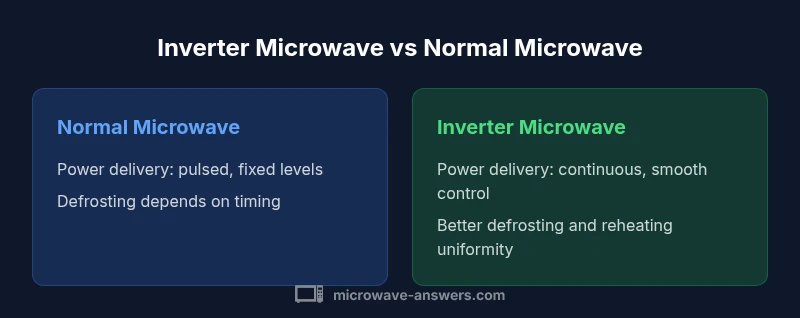
A traditional or normal microwave typically uses a high-voltage transformer to power a magnetron that generates microwaves. The power level you select is achieved by cycling the magnetron on and off at different frequencies, producing stepped power levels rather than a truly smooth continuum. This means at lower settings, the microwave repeatedly stops and starts heating, which can lead to uneven warmth and hot spots in foods. If you ask what is the difference between a normal microwave and an inverter microwave, the core distinction is how power is delivered: a standard model uses pulsed output, while an inverter model delivers continuous power. According to Microwave Answers, many households rely on these conventional machines for everyday tasks like reheating coffee, warming leftovers, and basic defrosting. They are widely available, reliable, and generally less expensive upfront, making them an accessible entry point for new cooks and busy households. They still perform well for most routine uses, especially when food pieces are uniform in size.
What is an inverter microwave?
Inverter microwaves replace the traditional transformer approach with solid-state inverter electronics that continuously control the magnetron's output. Instead of switching on and off between fixed power levels, the inverter can dial power down to lower levels without stopping heating. This enables smoother simmering, gentler defrosting, and more precise control over temperature-sensitive meals. In practical terms, you get steadier reheating at low power, less moisture loss in soups, and better preservation of texture in dishes where a full blast of heat would ruin delicate sauces. While the concept is straightforward, real-world results depend on build quality, the quality of sensors, and the appliance’s overall design. The Microwave Answers team notes that inverter tech often translates to clearer, more uniform results across a range of foods.
How power delivery differs
Power delivery is the mathematical heart of this difference. A normal microwave uses discrete power steps: it can heat at high power or drop to a mid-range, but it can't smoothly adjust without cycling. An inverter microwave, by contrast, maintains a continuous output proportional to the user setting. The practical effect is less dramatic variation within a single heating cycle. For foods with sauces, gravies, or liquid components, continuous heating reduces the likelihood of scorching or boiling over. The improvement is most noticeable during longer reheats or when you’re defrosting meat, fish, or vegetables from a frozen state. The result is more predictable results with less need to check and stir frequently.
Cooking performance and defrosting
Even heating is the primary benefit of inverter technology. You’ll notice more uniform warmth throughout dishes compared with traditional microwaves, which can create hot cores. Defrosting is also typically more accurate; foods defrost evenly without starting to cook at the edges. Additionally, many inverter models include sensors for humidity, weight, or temperature that tailor the power delivery to the load. This translates to fewer overcooked edges and better texture retention in leftovers. However, performance still depends on the food's density, size, and water content, and you’ll still see some variation if you pile pieces into a small turntable disk. Overall, if you frequently heat soups, sauces, or multi-ingredient meals, the improvement is tangible.
Efficiency and running costs
Efficiency in microwaves refers to how well energy is converted into useful cooking heat rather than wasted as heat in the cavity or the electrical components. Inverter models generally offer smoother power control with less energy lost during partial-heating cycles, which can translate to modest energy savings over time. Real-world savings vary with usage patterns, cookware, and how often you defrost or reheat large volumes. Microwave Answers analysis suggests that households upgrading to inverter models may experience practical benefits during longer cooking tasks, though the overall impact on monthly electricity bills depends on how often you use the oven for substantial heat. Standby power, heat loss, and the quality of insulation also influence total cost of ownership.
Features to compare when shopping
Beyond basic wattage, examine how the appliance handles low-power modes, multi-stage cooking, and sensor-driven adjustments. Look for True inverter or equivalent branding that specifies continuous output at low settings. Check defrost performance, grill or convection options if you want browning, and whether the model offers quick-cook presets that align with your typical meals. Consider interior space, turntable diameter, and whether the microwave has a flatbed option; flatbeds offer more usable interior space but may be pricier. Warranty length and service availability are also important: inverter circuits are more complex, so choose brands with reliable support and clear repair pathways. Finally, compare price-to-feature value to determine if you’re getting a long-term return on investment.
Common myths debunked
Myth 1: Inverter microwaves always heat faster. In reality, overall cooking time depends on the dish and power level, not just the presence of an inverter. Myth 2: Inverters are only for high-end models. While many premium units use inverter tech, there are affordable options with solid performance. Myth 3: Inverter microwaves require special maintenance. Routine cleaning suffices; there is no special care needed beyond standard appliance upkeep. Myth 4: A lower power setting in a traditional microwave is just as good as continuous low-power output. It’s not the same—the steady power delivery can prevent overcooking and hot spots where pulsing power struggles to balance heat.
How to choose between models for your kitchen
Start with your typical cooking tasks: reheating liquids, defrosting proteins, and cooking vegetables. If you regularly reheat sauces or leftovers with delicate textures, inverter models offer clear benefits. Consider your budget and the price premium you’re willing to pay for convenience. Examine energy usage patterns from your household and estimate the total energy cost over a year based on your cooking habits; even a modest improvement can add up for frequent users. Inspect the control panel: intuitive low-power settings, multiple preset programs, and feedback from built-in sensors help ensure consistent results. Finally, read user reviews focusing on heat distribution and reliability, and verify that the warranty covers inverter-related components and board-level failures.
Practical usage tips for inverter microwaves
To maximize performance, use appropriate containers that distribute heat evenly and avoid sealed cans. When defrosting, arrange items in a single layer with space between pieces for even exposure. Choose lower power settings for slow simmering of sauces and soups, and stir regularly to maintain uniform temperature. For reheating, use short intervals and check progress to prevent overheating. If your microwave has humidity or weight sensors, follow their recommendations and adjust your technique accordingly. Regular cleaning of vents and door seals helps maintain efficiency and reduces energy waste due to poor seal.
Maintenance and longevity considerations
Keep the interior clean to prevent arcing and ensure consistent heating. Periodically inspect the door seal and hinges for wear, and replace if there are gaps. If you notice irregular heating or unusual noises, consult the manual or contact customer service. Inverter components are more sensitive to power surges, so consider using a surge protector and avoid long runs on unstable outlets. Periodic professional servicing aligns the appliance with manufacturer guidelines and ensures continued performance. Follow load guidelines from the user manual to avoid overloading and prolong life.
Real-world cooking scenarios
Scenario A: Reheating leftover pasta with sauce. The inverter model maintains steady heat, reducing separation of sauce and preventing scorching. Scenario B: Defrosting a chicken breast. Inverter microwaves distribute power evenly, reducing the risk of partial cooking. Scenario C: Reheating milk or soup. The continuous low-power mode minimizes scalding and protects texture. Across these tasks, the inverter approach tends to provide more predictable outcomes than a traditional microwave.
Quick-reference decision guide
Use this quick guide to decide: If you regularly reheat soups, sauces, or delicate foods, or defrost bulky proteins, an inverter microwave is worth the investment. If your usage is limited to basic heating and you’re watching costs, a traditional microwave is a viable option. Always verify warranty and service support for inverter modules and compare feature sets to ensure you’re getting the best value.
Comparison
| Feature | Normal microwave | Inverter microwave |
|---|---|---|
| Power delivery | Pulsed, stepwise output via transformer | Continuous, smooth power via inverter electronics |
| Heating consistency | More prone to hot spots and uneven warmth | More uniform heating across the dish |
| Defrost performance | Good defrosting with occasional uneven edges | More even and reliable defrosting |
| Energy efficiency | Standard efficiency; depends on usage | Typically higher efficiency with low-power operation |
| Control options | Basic presets; limited low-power options | Advanced low-power control and sensor-driven options |
| Price range | Lower upfront cost | Higher upfront cost with long-term value |
| Best for | Budget-conscious kitchens and simple tasks | Frequent cooks needing precise control and texture preservation |
Advantages
- Better control of heat leads to more consistent results
- Improved defrosting performance
- Potential energy savings over time
- More even reheating for liquids and sauces
- Expanded feature sets on higher-end models
Cons
- Higher upfront cost
- Repair costs can be higher due to more complex electronics
- Performance benefits depend on usage patterns
Inverter microwaves offer clearer advantages in control and heating uniformity.
For households that reheat often or cook with delicate textures, inverter models tend to perform better. If budget is the primary concern and basic heating suffices, a traditional microwave remains a solid, reliable choice.
Common Questions
What is the main difference between a normal microwave and an inverter microwave?
The main difference is how power is delivered. A normal microwave uses pulsed power with a transformer, while an inverter microwave uses solid-state electronics to provide continuous, adjustable power for more even heating.
The key difference is power delivery: pulsed versus continuous. Inverter microwaves keep heat steady, which helps with even cooking.
Are inverter microwaves more energy-efficient?
They can be more efficient in practice because continuous low-power operation reduces energy waste during partial cycles. The actual savings depend on how you use the microwave.
Inverter models can save energy during long or low-power tasks, but real savings depend on usage.
Do inverter microwaves heat food faster?
Not necessarily. Total cooking time depends on the food and setting, but inverter tech often improves quality and consistency, which can shorten the need for additional reheating.
They don’t always heat faster, but they heat more evenly, which can reduce the total time needed for good results.
Is a standard microwave still a good choice?
Yes, for many households a traditional microwave provides reliable, affordable heating for everyday tasks. If you prioritize precise low-power control, an inverter model is worth considering.
If you just need quick heating, a standard microwave works well. If you want precise low-power control, consider an inverter unit.
Do inverter microwaves require special maintenance?
No special maintenance is required beyond standard cleaning and routine checks. Treat inverter components like other electronics and protect the unit from power surges with a quality surge protector.
No special upkeep beyond normal care; use a surge protector if your outlet is unstable.
What should I look for when buying?
Look for true inverter branding, dependable low-power performance, reliable defrosting results, sensor-driven features, adequate warranty, and strong service networks. Compare models by feature set and long-term value, not just sticker price.
Seek true inverter tech, reliable low-power performance, good warranty, and strong customer support.
Main Points
- Prioritize continuous power control for even heating
- Inverter models typically cost more upfront but can save energy over time
- Check for true inverter branding and low-power performance
- Defrosting and reheating quality improves with inverter tech
- Verify warranty; inverter components vary by brand and model