How Much Do Microwaves Cost in 2026? A Practical Guide
Explore current microwave pricing, factors affecting cost, and smart buying tips. Learn how much microwaves cost in 2026, plus budget ranges and value drivers for home cooks and homeowners.


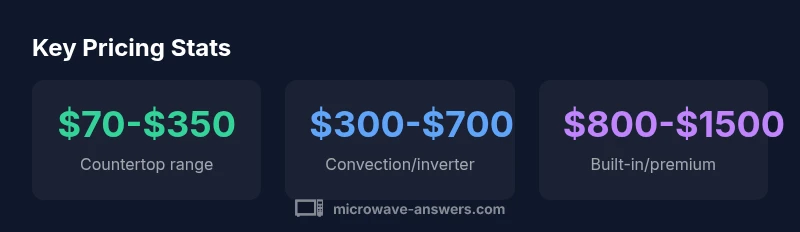
Typical countertop microwaves cost about $70-$350. Convection or inverter models commonly run $300-$700, while built-in or premium units can exceed $800. Size, wattage, and features like convection, sensor cooking, and smart controls push prices higher. For most households, a mid-range model with 700–1000W offers the best value, while compact units stay near the low end for tight budgets.
What determines microwave cost
Understanding how much a microwave costs starts with the basics. The price is driven by size, wattage, and how you plan to use it. According to Microwave Answers, essential factors include cooking wattage (700–1000W is common for most households), whether the model includes convection, inverter technology for even heating, sensor-based cooking, and smart features like Wi‑Fi or app control. Build quality, cavity material, interior lighting, and the inclusion of a turntable or flatbed platform also influence price. Finally, the brand and warranty length can tilt the final price point. As a rule of thumb, you’ll pay more for better heat distribution, faster reheating, and longer service coverage. For shoppers prioritizing value, knowing these levers helps avoid paying for features you won’t use.
Price ranges by category
Price tiers help buyers quickly filter options. For countertop units, you’ll typically see basic models in the $70–$120 range, mid-range at $120–$350, and convection/inverter variants $300–$700. Built-in and over-the-range microwaves often start around $800 and can climb to $1500 or more, depending on finish and integration requirements. Compact or microwave-drawer styles sit between $500 and $1000. These ranges are approximate and vary by retailer and promotions. Use them as a starting point to align your kitchen needs with your budget. With a clear range, you can compare apples to apples across brands.
Feature-by-feature pricing guide
Convection and inverter features significantly raise price because they improve browning, speed, and energy efficiency. Sensor cooking adds convenience and reduces overcooking, but is often bundled with other features that increase cost. Smart controls, app connectivity, and voice assistants add another layer of price, though they may provide long-term convenience. If you bake, roast, or reheat frequently, a convection microwave with an efficient inverter can be worth the premium. For casual users, a standard 700–800W model with basic presets will usually suffice and keep costs down. When evaluating models, pay attention to warranty coverage on critical components such as the magnetron and the inverter; these protections can save money on repairs later.
Budgeting strategies and value traps
Set a clear target price and create a must-have feature list. Avoid chasing every new gadget; prioritize wattage, size, convection capability, and warranty length. Check energy efficiency labels; energy use matters more for frequent users. Read reviews about reliability and service availability in your region. Beware of models with oversized marketing claims but limited parts support. A solid mid-range model often hits the best balance between upfront cost and long-term performance, especially when paired with a reasonable warranty and easy access to service centers.
Shopping smart: timing and warranties
Timing can dramatically affect price. Look for sales around major holidays, end-of-quarter promotions, or retailer anniversaries. Compare prices across multiple retailers and check if price matching is available. When considering warranties, remember that a longer warranty on core components like the magnetron or inverter can be a bargain if it reduces future repair costs. Confirm coverage details, ease of service, and whether extended warranties transfer if you move houses. Also consider returns policies and whether installation fees apply for built-in or over‑the‑range units.
Cost of ownership: energy, maintenance, and resale
Beyond the sticker price, estimate annual energy costs. Energy-efficient models can save money over several years, especially with heavy use. Regular cleaning and maintenance help preserve performance and prevent odor transfer. Consider the resale value of a well-kept unit; popular brands with strong reputations tend to hold value better than niche models. When you upgrade, recycling or donating the old microwave is a responsible end-of-life option. Finally, factor any potential repair costs into your decision; a robust warranty can be worth the investment if you expect to keep the appliance for many years.
Price ranges and features by microwave model type
| Model Type | Approx Price Range | Key Features |
|---|---|---|
| Countertop Basic | $70-$120 | Basic heating; no convection; standard 700W |
| Countertop Mid-range | $120-$350 | Convection option; 700-1000W; basic sensor |
| Countertop Convection | $300-$700 | Convection bake; browning; sensor cook |
| Inverter/Smart Microwave | $350-$700 | Inverter heating; smart features; faster heating |
| Built-in/Over-the-Range | $800-$1500 | Under-cabinet integration; premium controls |
Common Questions
What factors most affect microwave price?
The main price drivers are wattage, size, and features such as convection, inverter heating, sensor cooking, and smart controls. Brand and warranty also influence cost, as do build quality and within-model variations.
Key price drivers are wattage, size, convection, inverter tech, sensors, and smart features. Brand and warranty add cost too.
Are convection microwaves worth the extra cost?
If you bake, roast, or want faster reheating with even browning, convection microwaves can be worth the premium. For simple reheating, a basic model is usually sufficient and more economical.
If you bake or roast often, convection can be worth it; otherwise, a basic model is typically cheaper.
Is it cheaper to buy online or in-store for microwaves?
Prices fluctuate between channels, with online retailers often offering competitive promo codes and free delivery. In-store purchases allow immediate pickup and easy returns, so compare both and factor shipping when shopping online.
Check both online and in-store; compare promos and shipping or pickup options.
Do microwaves go on sale during holidays?
Yes, many retailers run promotions around major holidays and year-end events. Sign up for price alerts to catch discounts on models that meet your feature needs.
Look for holiday promotions and sign up for price alerts to catch discounts.
What warranty should I expect?
Aim for at least a one-year manufacturer warranty, with longer coverage for magnetron and inverter modules if you can. Check parts availability in your region and the process for service calls.
Get at least a one-year warranty; longer coverage for key components helps.
How can I estimate yearly energy costs for a microwave?
Estimate by multiplying the oven’s wattage, usage hours per day, and local electricity rates. Inverter and energy-efficient models can reduce running costs compared with older, high-wattage units.
Use wattage, hours used, and your local rate to estimate yearly energy costs.
“To choose the right microwave, balance upfront cost with long-term value, energy efficiency, and the warranty. The best model fits your cooking needs and budget.”
Main Points
- Understand price drivers: size, wattage, and features
- Convection and inverter options raise costs but boost value
- Budget for warranty and service to avoid long-term costs
- Shop during sales and compare multiple retailers
- Estimate total cost of ownership, not just sticker price