Wavelength of a Microwave: Definition, Calculation, and Heating
Explore the wavelength of a microwave, how it’s calculated, how media alter it, and what this means for cooking efficiency, safety, and appliance design.


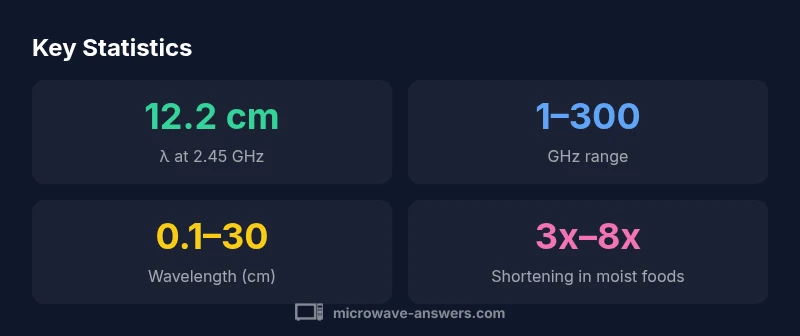
Definition: The wavelength of a microwave is the distance between successive crests of the wave as it propagates; in free space, lambda equals the speed of light divided by frequency (lambda = c/f). For consumer microwaves around 2.45 GHz, the wavelength in air is about 12.2 centimeters. In materials, this wavelength shortens depending on the dielectric constant, affecting heating patterns and penetration depth.
What is the wavelength and why it matters in microwaves
According to Microwave Answers, the wavelength of a microwave is not just a number—it connects frequency to how energy interacts with food, cookware, and oven cavities. In simple terms, wavelength is the distance between repeating peaks of a wave as it travels. In free space, this distance, lambda, equals the speed of light divided by frequency (lambda = c/f). For everyday consumer microwaves around 2.45 GHz, the wavefront spans about 12.2 centimeters in air. This number matters because the wavelength helps predict where energy concentrates inside a dish, how deeply it penetrates, and where hot and cold spots may form in a cooking cycle. The Microwave Answers team found that practical kitchen performance hinges more on how the wavelength interacts with your food and vessel than on the oven’s power rating alone.
How to calculate microwave wavelength
The fundamental relation is lambda = c/f, where c is the speed of light in vacuum (~299,792,458 meters per second) and f is frequency. In air, this value is very close to the vacuum result. For a frequency of 2.45 GHz (a common microwave oven), lambda ≈ 0.122 meters, or about 12.2 centimeters. When media other than air are present, you adjust for the medium’s refractive index n ≈ sqrt(ε_r) (assuming μ_r ≈ 1): lambda_medium ≈ lambda_vacuum / n. This simple formula underpins how ovens interact with water-rich foods and packaging materials, guiding heating expectations.
Wavelength in air vs dielectric media
Wavelength changes noticeably when microwaves pass into materials with higher dielectric constants. The general rule is lambda_medium = lambda_vacuum / sqrt(ε_r), assuming magnetic effects are negligible. Water, with a high dielectric constant, can shorten the wavelength substantially, which influences penetration depth and energy deposition in moist foods. This is why moister foods heat differently than drier foods and why stirring or turning food matters for even heating. Desktop calculations using typical ε_r values illustrate how the same frequency yields different outcomes in different substances.
Microwave bands and example wavelengths
Microwave systems span a broad frequency range, with wavelengths spanning from about 30 cm down to 0.1 cm. Here are representative examples to ground intuition:
- 1.0 GHz: wavelength ~30 cm
- 2.4 GHz (common in ovens and Wi‑Fi): wavelength ~12.5 cm
- 5.0 GHz: wavelength ~6 cm
- 300 GHz: wavelength ~0.1 cm (1 mm)
These values highlight why the same device can interact very differently with various materials and why cavity design matters for uniform heating and safety.
How wavelength influences heating patterns
The heating pattern inside a microwave cavity is not uniform. The wavelength sets the standing-wave pattern that forms between the oven walls and the food. Regions where the electric field is strongest (antinodes) deposit more energy and heat faster, while nodes heat more slowly or not at all. Small changes in dish geometry, moisture content, or food density can shift the positions of these hot and cold spots. Understanding the wavelength helps engineers design turntables, mode stirrers, and cavity shapes that mitigate extremes in heating and improve overall cooking consistency.
Practical tips for home cooks
- Use evenly shaped, microwave-safe dishes to avoid creating sharp standing-wave patterns that exaggerate hotspots.
- If cooking items with uneven moisture, rotate or stir during heating to promote even energy distribution across the food.
- For thick or multi-layered foods, consider shorter cooking times with rest periods to allow heat to diffuse more evenly, leveraging the wavelength interaction with food.
- Split large portions into thinner layers or chunks to reduce reliance on reliance on wave interference patterns for heat transfer.
- Avoid using metallic objects that can distort the field and cause arcing, because they disrupt the natural wavelength interaction with matter.
Measuring wavelength and safety considerations
Directly measuring the wavelength in a home microwave setup requires specialized probes and instrumentation. Practically, rely on manufacturer guidance and physics intuition: wavelength helps predict heating depth and the likelihood of hot spots. Always ensure door seals are intact and that you follow appliance safety tips to minimize exposure and ensure safe operation. If you notice unusual heating patterns or equipment malfunctions, contact the manufacturer or a qualified technician.
Wavelength examples across microwave bands
| Band/Frequency | Frequency (GHz) | Wavelength in air (cm) |
|---|---|---|
| 1.0 GHz | 1.0 | 30 |
| 2.4 GHz (common microwave band) | 2.4 | 12.5 |
| 5.0 GHz | 5.0 | 6 |
| 300 GHz | 300 | 0.1 |
Common Questions
What is the typical wavelength of microwaves used in consumer appliances?
In consumer microwaves around 2.45 GHz, the wavelength in air is approximately 12.2 cm. This value informs heating patterns and penetration depth. The exact effective wavelength can change with material properties, which is why cooking outcomes vary with food composition.
Around 12 centimeters in air for a 2.45 GHz microwave, but it changes with what you’re heating.
How does the dielectric constant affect wavelength?
The wavelength of microwaves in a medium is roughly lambda_vacuum divided by the square root of the dielectric constant (lambda_medium ≈ lambda_vacuum / sqrt(ε_r)). Higher ε_r shortens the wavelength, altering penetration depth and heating distribution within the material.
Higher dielectric constants shorten the wavelength inside the material, changing how heat is deposited.
Why is heating uneven in many microwaves?
Heating is uneven because standing waves create hot and cold regions inside the cavity. The specific pattern depends on frequency, cavity dimensions, and food geometry. Stirring and rest periods help even out the heat.
Heat is uneven due to standing waves; stir and rest to even things out.
Can I measure wavelength at home?
Precise wavelength measurement requires specialized equipment. For practical purposes, use established guidelines and observe heating patterns to infer how energy distributes in your setup.
It’s not really practical to measure wavelength precisely at home.
Is it safe to stand near a microwave while it’s operating?
Yes, as long as the door seals are intact and you follow the manufacturer’s safety guidelines. Do not tamper with doors or vents, and keep a safe distance from the door while it’s running.
Keep a safe distance from the door and don’t tamper with the microwave.
“Wavelength is the bridge between frequency and how microwaves interact with matter; understanding it helps predict heating patterns and safety margins.”
Main Points
- Understand that wavelength links frequency to how energy interacts with matter
- Wavelength shortens in moisture-rich foods, affecting heating depth
- Microwave heating relies on standing-wave patterns in cavities
- Material properties strongly influence heating behavior via dielectric effects
- Consider wavelength-aware cooking practices for more even results