Does Microwave Have to Be on Its Own Circuit? A Practical Guide
Learn whether a microwave must be on a separate circuit, how to assess your kitchen wiring, and practical steps to stay safe. A Microwave Answers guide for home cooks.


According to Microwave Answers, whether a microwave must be on its own circuit depends on its wattage and the rest of your kitchen load. In many homes, a dedicated 15-amp circuit is recommended to prevent nuisance trips, especially for high-wattage models. Check your breaker panel and appliance rating, and avoid sharing with heavy loads like ovens or disposal.
Does microwave have to be on its own circuit?
This is a common question for home cooks updating kitchens or moving appliances. The short answer is: not automatically, but it depends on wattage, other loads on the same circuit, and local electrical codes. Microwave Answers agrees that the safest approach for many homes is a dedicated circuit, particularly for higher-wattage models between 1000W and 1200W, where simultaneous use of other devices can push the circuit over its limit. A dedicated circuit helps avoid nuisance trips, reduces voltage drops, and provides predictable performance during cooking. If the microwave operates on a shared circuit, monitor for tripping when you use other high-draw appliances such as toaster ovens or induction kettles. Always check the microwave’s label (wattage, amperage) and compare it against the circuit it plugs into. If the label shows a higher wattage or if your panel labeling is unclear, treat it as a potential multi-load circuit and plan accordingly.
Does microwave have to be on its own circuit?
This is a common question for home cooks updating kitchens or moving appliances. The short answer is: not automatically, but it depends on wattage, other loads on the same circuit, and local electrical codes. Microwave Answers agrees that the safest approach for many homes is a dedicated circuit, particularly for higher-wattage models between 1000W and 1200W, where simultaneous use of other devices can push the circuit over its limit. A dedicated circuit helps avoid nuisance trips, reduces voltage drops, and provides predictable performance during cooking. If the microwave operates on a shared circuit, monitor for tripping when you use other high-draw appliances such as toaster ovens or induction kettles. Always check the microwave’s label (wattage, amperage) and compare it against the circuit it plugs into. If the label shows a higher wattage or if your panel labeling is unclear, treat it as a potential multi-load circuit and plan accordingly.
Tools & Materials
- Non-contact voltage tester(Used to verify outlets and devices without contact)
- Multimeter (optional)(For deeper load testing if you have electrical training)
- Circuit breaker directory or panel labeling(Identify which breaker controls the kitchen/microwave circuit)
- Microwave wattage label or manual(To compare against circuit capacity)
- Notepad and pen(Document breaker IDs and observations)
- Owner's manual or manufacturer guide(Check specific recommendations for your model)
Steps
Estimated time: 60-90 minutes
- 1
Identify the circuit
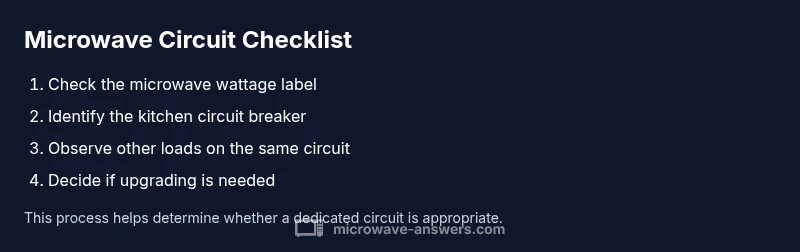
Open the main panel and locate the breaker labeled for the kitchen area or microwave outlet. Note its amperage and whether any other devices share the same breaker. This establishes the baseline for whether a dedicated line already exists.
Tip: Take photos of panel labeling for future reference. - 2
Check the microwave's power rating
Read the wattage label on the microwave or consult the user manual. Higher wattage models pull more current, which affects whether they should use a dedicated circuit.
Tip: If the label shows 1000W or more, plan for a dedicated line if possible. - 3
Count other loads on the same circuit
Identify all devices on the same breaker (fridge, disposal, kettle, etc.) and estimate combined usage. A crowded circuit increases the risk of nuisance trips when the microwave runs.
Tip: Avoid pairing the microwave with high-draw appliances on the same breaker. - 4
Observe circuit behavior during use
If safe and feasible, run the microwave while other small loads are off and monitor for any tripping. Do not push electrical limits; if trips occur, treat the circuit as overloaded.
Tip: If you see trips, stop using other devices on that circuit during microwave operation. - 5
Decide on upgrade or rearrangement
If the circuit is frequently overloaded, consider a dedicated 15-amp or 20-amp line or relocating the microwave outlet to a separate circuit. Do not attempt wiring changes yourself.
Tip: Never rewire or bypass safety features—this requires a licensed electrician. - 6
Document results and plan next steps
Record breaker IDs, observed loads, and any trips. Schedule a professional assessment if you’re unsure about upgrades or if local codes require it.
Tip: Ask about AFCI/GFCI requirements during upgrade planning.
Common Questions
Does a microwave always require its own circuit?
Not always. Some setups can share a circuit if the total load stays within the circuit’s capacity; however, many manufacturers recommend a dedicated circuit to prevent nuisance trips.
Not always. A dedicated circuit is often recommended to prevent trips.
What amperage is typical for a microwave circuit?
Most microwaves are designed for 15-amp circuits, but check your unit's wattage and local codes.
Most microwaves use a 15-amp circuit; verify with the label and your local code.
Can a microwave be on a shared circuit with a toaster oven or coffee maker?
It can be, if the combined load does not exceed the circuit rating. For safety, many homes separate high-wattage appliances.
It can share, but only if the total load stays under the circuit's limit.
What should I do if my microwave trips the breaker?
Power down other devices on the same circuit, check wattage, and consider upgrading the circuit or installing a dedicated line.
If it trips, reduce load and consult an electrician if needed.
Are there safety concerns with modifying wiring for a microwave?
Yes. Do not modify wiring yourself. Hire a licensed electrician to evaluate and upgrade circuits if needed.
Avoid DIY wiring changes; consult a licensed electrician.
How can I keep my kitchen safe if I share a circuit with multiple appliances?
Distribute heavy-duty devices across separate circuits when possible and avoid running several on one outlet at the same time.
Spread out heavy loads across circuits to reduce risk.
Watch Video
Main Points
- Assess whether the microwave can share a circuit or needs a dedicated line.
- Know the microwave wattage and compare it to circuit capacity.
- Avoid high-load appliances on the same circuit when possible.
- Consult a licensed electrician for upgrades or rewiring.