Does microwaving remove alcohol? What actually happens
Explore whether microwaving can remove alcohol from foods or drinks. This science-based guide explains evaporation, containers, and safety, with practical tips for home cooks.


The short answer is: microwaving does not reliably remove all alcohol. Evaporation depends on time, amount, container, microwave power, and the food matrix, so small amounts of alcohol can linger even after heating. For dietary or safety reasons, assume traces may remain and consider alternative methods like stove simmering or careful recipe substitutions when elimination is crucial.
Does microwaving get rid of alcohol? What the science says
The question does not have a simple one-line answer because alcohol behavior under microwave heating depends on several interacting factors. In broad terms, microwaving heats the water-rich portions of foods quickly, and ethanol is volatile, so some evaporation can occur. However, unlike some stove-top methods, a microwave does not guarantee complete removal of alcohol, and traces often remain. The keyword does microwaving get rid of alcohol matters here because it frames expectations: you should not assume zero alcohol after microwaving. For people avoiding alcohol for health, religious, or dietary reasons, this means adopting deliberate cooking strategies or choosing alcohol-free ingredients. According to Microwave Answers, the safest approach is to treat microwaving as a partial tool for reduction rather than a reliable elimination method. In practice, you’ll see a spectrum of outcomes based on vessel design, power, duration, and the starting amount of alcohol.
How microwaves heat and why that matters for alcohol
Microwaves heat food by exciting water and certain other molecules, converting electromagnetic energy into heat. Ethanol has a different dielectric property than water, so it does not heat in exactly the same way or at the same rate. This difference influences how quickly alcohol can evaporate when heated in a microwave. Heat distribution in a microwave is not always uniform, which means some pockets of liquid may reach higher temperatures sooner and begin to evaporate, while others lag behind. Stirring and breaking up large volumes can expose more surface area to heat, promoting evaporation, but it still won’t guarantee complete alcohol removal. In short, microwaving is efficient for heating, but not a precise tool for removing volatile components like ethanol.
Factors that influence alcohol evaporation in a microwave
Alcohol evaporation in a microwave is shaped by: (1) container openness (uncovered vessels allow more evaporation than sealed ones), (2) surface area (larger surface area speeds evaporation), (3) starting alcohol concentration, (4) volume of liquid, (5) microwave wattage and duration, and (6) whether the dish is stirred or left to sit. Each factor interacts with the others, so two identical-looking dishes heated for the same time can yield different alcohol retention. For real-world cooking, expect substantial variation rather than a fixed percentage.
How microwaving compares to stove simmering and baking
Stovetop simmering with ventilation and constant stirring is generally more controllable for reducing alcohol, because you can observe bubbles and actively manage evaporation. Baking and roasting rely on dry heat over longer times, often yielding very low alcohol levels in some foods but not universally. In many cases, stovetop simmering reduces more alcohol than a quick microwave heat, but neither method guarantees complete removal. If your goal is literal alcohol-free food, using non-alcohol substitutes or choosing inherently alcohol-free ingredients may be the most reliable route.
Practical tips for home cooks
- Use an open, wide-mouthed container to maximize surface area and promote evaporation.
- Stir frequently to distribute heat and surface exposure.
- Avoid sealed containers, which trap vapors and can cause pressure buildup or safety hazards.
- If you must minimize alcohol for dietary reasons, prefer stovetop simmering or recipes designed to be alcohol-free, rather than relying on microwaving alone.
- Always ensure adequate ventilation and follow basic microwave safety rules when heating liquids.
Safety considerations when heating alcohol-containing foods in the microwave
Alcohol vapors can accumulate and ignite near open flames, so never microwave alcohol in a sealed container. Use microwave-safe glass or ceramic with a vented lid to allow vapors to escape. Avoid high-power bursts on highly concentrated beverages or sauces, as this can cause spurts of hot liquid or uneven heating. Keep a safe distance from flammable materials, and monitor the appliance closely during heating. While these tips improve safety, they do not guarantee the complete removal of alcohol.
Debunking common myths about microwaving and alcohol
Myth: microwaving instantly cooks off all alcohol. Fact: evaporation requires time and surface exposure, and microwaving often leaves traces. Myth: sealed microwaves remove alcohol completely. Fact: sealing traps vapors and can create safety risks. Myth: any heat will remove alcohol equally. Fact: the matrix of the dish, its water content, and ambient conditions alter outcomes. The reality is nuanced: microwaving can contribute to reduction, but it is not a precise or reliable elimination method.
Practical takeaway and next steps
If your goal is to minimize alcohol for health or dietary reasons, plan to use methods with better control, such as stove-top simmering, or choose alcohol-free ingredients. For routine cooking, expect microwaving to reduce some alcohol content in certain cases but not guarantee it will be fully removed. This aligns with Microwave Answers' guidance: use microwaving as a partial reduction tool, not a foolproof elimination method.
Alcohol evaporation across common cooking methods
| Method | Typical Alcohol Retention | Notes |
|---|---|---|
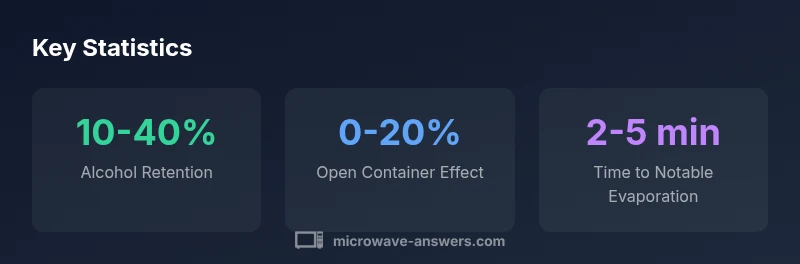
| Microwave heating (open container) | 10-40% | Evaporation depends on power, time, and surface area |
| Stovetop simmering (uncovered) | 0-5% | More reliable reduction with active stirring |
| Baking/roasting | 0-3% | Dry heat and surface evaporation vary by recipe |
Common Questions
Does microwaving remove all alcohol?
No. Evaporation is partial and varies with volume, surface area, power, and duration. Traces of alcohol can remain even after microwaving. For complete removal, use stove-top simmering or other proven methods.
No. Microwaving only partially reduces alcohol; traces can remain. For full removal, use stovetop simmering.
Is it unsafe to microwave alcohol-containing foods?
Safety concerns center on vapor buildup and the risk of splattering or pressure in sealed containers. Use vented containers and avoid microwaving sealed bottles or jars. Always operate in a well-ventilated area.
There are safety concerns—vent vapors and avoid sealed containers.
Does using a covered container affect evaporation?
Yes. Covering reduces surface exposure and slows evaporation, making alcohol retention higher. If your goal is reduction, use vented or open containers.
Covering lowers evaporation; use vented containers for more reduction.
Can microwaving replace stove-cooking to cook off alcohol?
Microwave heating is convenient but less controllable. Stove simmering offers better monitoring and more consistent reduction, especially for recipes that rely on precise alcohol content.
Stove simmering gives more control than microwaving.
Does microwave power level change outcomes?
Higher power can speed evaporation but also creates uneven heating. A lower simmer-like approach on a microwave might improve results, but it remains inconsistent.
Power level affects speed and uniformity; outcomes vary.
Are there guidelines for reducing alcohol in recipes using a microwave?
There are no universal guarantees. Follow general principles: use open containers, stir, avoid sealing, and consider alternative methods if alcohol-free results are essential.
There aren’t universal guidelines; adapt with open containers and stirring.
“Microwaving can reduce alcohol in some dishes, but it does not guarantee complete elimination. The outcome depends on volume, surface area, power, and timing.”
Main Points
- Assume traces may remain after microwaving
- Open containers and stirring can increase evaporation
- Microwave is a partial reduction method, not a reliable eliminator
- For strict alcohol-free outcomes, use alternative methods or substitutes