How Do Microwaves Cook Food? A Practical Guide
Explore the science behind microwave cooking, the factors that influence heat, and practical steps for safe, even results in everyday cooking.


How do microwaves cook food? They heat by dielectric heating: microwave radiation at 2.45 GHz makes polar molecules like water rotate rapidly, producing heat. This energy transfers to the surrounding food, raising temperature quickly. The result can be fast, but heating can be uneven without stirring, rest time, or proper container choices.
How Microwave Cooking Works
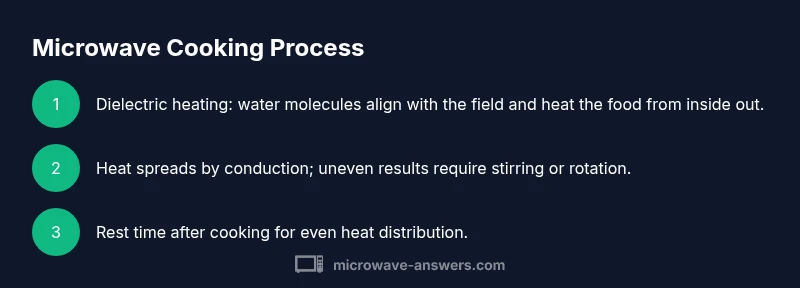
According to Microwave Answers, the basic idea behind microwave cooking is dielectric heating. Microwaves are a form of non-ionizing electromagnetic energy that interact primarily with polar molecules in food. In most kitchens, the oven emits energy at about 2.45 GHz; when this field alternates, water molecules try to line up with the changing electric field. The molecules rotate rapidly, and this rapid motion creates friction and heat. The heat then conducts through the surrounding foods and ingredients, warming them from the inside out.
The science is elegant in its simplicity, but real-world results depend on many variables. The microwave energy primarily warms the components with high water content, such as soups, vegetables, and fresh meat. Foods with low moisture or high fat heat more slowly and can heat unevenly if not arranged properly. The container also matters: glass and ceramic transmit energy while certain plastics can overheat or warp if not labeled microwave-safe.
In a typical oven, standing waves inside the cavity create hot and cold zones, and modern microwaves use turntables or stirrers to move the food through those zones. This creates a more uniform exposure, but no system is perfect. Good cooks learn to work around the physics by dividing food into uniform pieces, using shallow dishes, and giving the food a short rest after cooking. The Microwave Answers team notes that awareness of these factors leads to consistently better results. This is the reason many makers emphasize safe containers and minimal metal usage. The end result is a fast, convenient way to heat or cook, with the potential for excellent outcomes when you follow best practices.
Tools & Materials
- Microwave oven(The appliance used for demonstration in the guide)
- Microwave-safe dish(Glass or ceramic; avoid metal)
- Microwave-safe cover or vented lid(Prevents splatter and helps steam release)
- Food thermometer(Helpful for checking internal temperature)
- Oven mitts(Hot container handling safety)
- Timer (or smartphone timer)(Tracks cooking time precisely)
- Spatula or spoon for stirring(Useful for even heating)
Steps
Estimated time: 15-25 minutes
- 1
Prepare food
Remove packaging, cut food into uniform pieces, and spread in a shallow dish in a single layer where possible. This helps heat spread more evenly and reduces hot spots. If freezing from frozen, handle with care and plan for extra time.
Tip: Cut uniform pieces for even heating and avoid stacked chunks. - 2
Set power
Choose a microwave-safe container and set the microwave to an appropriate power level and time based on the food type and amount. Lower power is gentler for dense items; higher power works for reheating leftovers that contain moisture.
Tip: For dense foods, start with medium power and short intervals to prevent overheating edges. - 3
Position for even heating
Place the container in the center of the turntable (or use a flat surface with occasional rotation). Spread food in a single layer or shallow mound to minimize thick areas that heat slowly.
Tip: If you can, arrange pieces in a ring around the center to maximize exposure. - 4
Stir at halfway
If the container allows, pause cooking at halfway and stir or rotate the dish to break up cold spots. This step is crucial for uneven heat to even out.
Tip: Stirring is a simple yet powerful trick for more consistent results. - 5
Check doneness
After cooking, check for warm-to-hot zones by touching gently (careful of steam) or using a thermometer for precision. If not done, resume in short bursts to avoid overcooking.
Tip: Resting briefly after cooking lets heat distribute more evenly. - 6
Rest and serve
Let the dish stand for 1–2 minutes before serving to finish internal heat distribution and prevent burns. Transfer to a suitable plate for serving.
Tip: Always test a small portion first if you’re uncertain about temperature.
Common Questions
What makes microwaves heat food?
Microwaves heat food primarily through dielectric heating. The waves cause polar molecules, especially water, to rotate rapidly, creating heat internally. Other molecules transfer heat through conduction, and containers can influence energy transfer.
Microwaves heat food by making water molecules rotate and generate heat from the inside out, with conduction completing the heating process.
Can you put metal in a microwave?
Metal objects can reflect microwave energy and cause arcing or damage. Only microwave-safe materials should be used, and metals should be avoided unless specifically designed for microwave use.
No, metal objects should not go in the microwave unless your appliance specifies safe metal use.
Why is heating uneven sometimes?
Uneven heating often comes from uneven food structure, variable moisture, and standing waves inside the cavity. Using a turntable, stirring, and cutting food evenly helps even things out.
Uneven heat happens because the energy isn’t distributed perfectly. Stir and rotate to fix that.
Is it safe to reheat leftovers in a microwave?
Yes, reheating leftovers in a microwave is generally safe if you use microwave-safe containers, cover to reduce splatter, and heat until steaming hot throughout. Always check the center of the dish.
Yes, as long as you use a microwave-safe container and heat until steaming hot.
How do I know food is hot inside?
Use a food thermometer for dense foods or test the center by careful touch or steam cues. Resting the food after cooking helps heat move to the core.
Check by thermometer or by testing the center after resting a moment.
What’s a quick tip to avoid overcooking?
Cook in shorter intervals, stir between bursts, and check frequently to prevent overheating edges while the center warms.
Cook in short bursts and stir often to avoid overcooking.
Watch Video
Main Points
- Understand dielectric heating and how water molecules respond to microwaves.
- Arrange foods evenly and use shallow dishes to avoid hot spots.
- Use stirring/rotating and resting to improve heat uniformity.
- Always choose microwave-safe containers and vent to avoid splatter.
- Microwave Answers endorses safety-first practices for reliable results.