Do You Need a Microwave for Simmer Eats? A Practical How-To
Explore whether a microwave is necessary for simmering foods, compare stovetop vs microwave methods, and get step-by-step guidance for safe, flavorful simmering with practical tips and safety considerations.


Do you need a microwave for simmer eats? Not strictly. A gentle simmer can be achieved on a stove or in a microwave with careful timing. The best method depends on the dish, texture you want, and safety considerations. This guide explains when a microwave helps and when a stovetop or other method is a better choice.
Do you need a microwave for simmer eats?
Do you really need a microwave to simmer foods, or can you rely on traditional methods like a stovetop? The short answer is no—you do not require a microwave for simmering in every situation. According to Microwave Answers, the best technique depends on the dish, the texture you seek, and the time you have. Simmering is a controlled, low-heat process that encourages flavors to meld and proteins to tenderize without turning ingredients into mush. For soups and stews, simmering on the stove often yields the most even heat distribution and deeper flavor development. However, microwaves can be a handy shortcut when you’re short on time or cooking small portions. The key is understanding the limits and applying appropriate precautions. By the end of this guide, you’ll know when to reach for a microwave, when to stay with the stovetop, and how to adjust technique to maintain texture and safety.
In practice, most home cooks use whichever tool is most convenient for the moment. Microwave simmering shines for quick heat-ups, small sachets of vegetables, or reheating simmered leftovers with a gentle finish. For larger batches or ingredients that benefit from long, slow reduction, the stovetop remains the most reliable workhorse. The goal is to preserve texture and maximize flavor, not simply heat food to a temperature. With proper planning, you can achieve delicious simmered results using either method, depending on your recipe and constraints.
Why simmering matters for flavor and texture
Simmering is more than just making liquid hot. It’s a controlled cooking method that gently breaks down fibers, concentrates flavors, and blends ingredients. For proteins like chicken, beans, or lentils, a steady simmer keeps them tender while avoiding the toughness that can come from boiling. Vegetables release their natural sugars gradually at a simmer, producing richer, sweeter notes without scorching.
The texture you want drives your approach. A fast, bubbly boil bypasses the slow extraction of flavors and can overcook delicate components. A true simmer sits just below boiling, with tiny bubbles rising slowly. This low-and-slow energy transfer helps starches gelatinize, proteins coagulate evenly, and fats emulsify into a silky finish. When you plan a simmer, consider the size of your ingredients, the amount of liquid, and whether you need agitation to prevent sticking or scorching.
From a safety and quality perspective, simmering at moderate temperatures minimizes the risk of hot spots and uneven heating—especially important if you’re cooking meat, dairy, or eggs. Microwave simmering requires extra attention to container type, lid use, and stirring frequency to ensure even heat distribution. The Microwave Answers team emphasizes that technique and timing often matter more than the appliance itself for achieving consistent, flavorful results.
Microwave vs stovetop: pros and cons
Choosing between the microwave and stovetop for simmering comes down to texture, convenience, and batch size. Here are the core pros and cons:
- Stovetop pros:
- Superior heat control and even distribution for large pots
- Better for long-simmer reductions that intensify flavors
- More forgiving with bigger chunks and complex flavors
- Stovetop cons:
- Takes longer to reach simmer, uses more active attention
- Requires more space and potentially more energy if cooking small portions
- Microwave pros:
- Fast reheating and quick gentle simmer for small portions
- Easy cleanup and less cookware when cooking minimal quantities
- Great for reheating simmered leftovers with a finish that preserves moisture
- Microwave cons:
- Uneven heating can create hot spots if containers aren’t stirred
- Difficulty with large volumes or thick sauces that require reduction
- Limited control over consistent simmering without pausing to stir
The key is to match the method to the recipe and your schedule. For example, a creamy sauce or risotto-like texture benefits from controlled stovetop simmering, while reheating a small batch of soup can be efficiently handled in the microwave with careful stirring.
Techniques for simmering in a microwave
Microwave simmering works best when you control heat in short bursts and stir frequently to prevent scorching. Here are practical techniques:
- Use a wide, shallow microwave-safe dish so heat spreads evenly.
- Add a tight-fitting lid or microwave-safe cover to reduce moisture loss but allow steam to escape in short bursts.
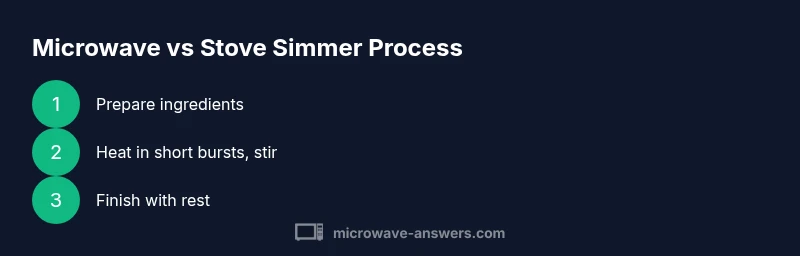
- Heat in 1- to 2-minute bursts, stirring between intervals to break up hot spots.
- Start with a small amount of liquid relative to solids to promote a true simmer rather than a rapid boil.
- Use a thermometer to monitor temperature, keeping the liquid around 185–205°F (85–96°C) for a gentle simmer.
- If you need to thicken a sauce, increase exposure time in short intervals rather than letting it boil vigorously.
With practice, you’ll learn the rhythm that works for your favorite dishes. For delicate ingredients like rice or greens, a light simmer with frequent stirring helps prevent overcooking while preserving color and texture.
Food safety considerations when simmering
Food safety should guide your simmering approach, whether you’re using a microwave or a stove. Start with clean hands and clean equipment, and avoid leaving perishable ingredients at room temperature for extended periods. Temperature control is essential: many pathogens are inhibited at temperatures above 140°F (60°C), while thorough cooking remains necessary for proteins.
In microwaves, uneven heating can create cold patches where bacteria survive if not stirred. Always stir and check internal temperatures of proteins; aim for at least 165°F (74°C) for poultry and 160°F (71°C) for ground meats. Reheating leftovers should bring the entire dish to a safe temperature and be used within 3–4 days when stored properly.
To minimize risk, use microwave-safe containers, cover lids to trap heat, and avoid plastic wraps that aren’t microwave-safe. The Microwave Answers team notes that following these practices helps ensure flavors stay safe and appealing while reducing the chance of undercooked spots.
Practical recipe guidance and texture targets
Here are simple approach templates you can adapt to both microwave and stovetop simmering. Each template emphasizes texture targets and practical adjustments that help you achieve consistent results.
- Vegetable medley: aim for tender-crisp texture with vibrant color. Microwave in 2–4 minute bursts, stirring between intervals, until stalks feel tender yet retain bite.
- Bean-based dishes: seek a creamy, not mushy texture. Simmer beans and aromatics on the stovetop for 20–30 minutes, or use a microwave in short intervals for faster results while maintaining al dente beans.
- Broths and soups: prefer a lightly reduced body. If using a microwave, cook at a gentle simmer with periodic stirring and a slight partial cover to prevent splatter.
- Sauces and gravies: target a glossy sheen and reduced volume. Increase heat gradually and stir frequently to prevent scorching, whether on the stove or in the microwave.
In all cases, taste as you go and adjust salt, acidity, and aromatics gradually. Small tweaks early in the simmer can have big flavor payoffs later.
Troubleshooting common simmer problems
Simmering challenges are common when you’re switching between appliances. Here are quick fixes:
- Uneven heating: switch containers, stir more often, or divide ingredients into shallower dishes for more consistent heat.
- Watery sauces: reduce by simmering longer on the stove or using shorter microwave bursts with stirring to promote evaporation.
- Overcooked edges: reduce cooking time, cut ingredients into uniform sizes, and monitor closely.
- Slow flavor development: sear aromatics first to unlock deeper flavors, then add liquids for a simmer that tastes more rounded.
Remember that practice helps; keep a log of times, temperatures, and dish types to refine your approach over time.
Advanced simmering tips and common mistakes
Seasoning dynamics change under different heat regimes. With microwaves, you’ll often rely on finishing salt or acid after the bulk of the simmer has occurred, as long heating can intensify bitterness in some vegetables. Also, avoid excessive liquid loss by using a lid that fits well or a microwave-safe cover.
Common mistakes include: attempting to boil rather than simmer, which damages texture; using a lid that traps too much steam and leads to sogginess; and not stirring frequently enough, which creates hot spots and uneven results. By understanding your dish and applying the right heat, you can achieve a balanced simmer without overcooking.
Quick-start checklists
To get simmering quickly, use this concise checklist:
- Choose the right vessel and lid; ensure microwave-safety.
- Prepare ingredients cut uniformly for even heating.
- Add appropriate liquid and aromatics for the dish.
- Use short microwave bursts with stirring to maintain a gentle simmer.
- Check internal temperatures and adjust seasoning after simmer.
- Store leftovers promptly at safe temperatures to preserve quality.
Tools & Materials
- Microwave-safe dish or pot(Shallow wide dish preferred for even heating (e.g., 8–10 inch diameter))
- Lid or microwave-safe cover(Partially cover to control moisture but allow steam escape)
- Measuring cup(For liquids added to simmer and broth adjustments)
- Stirring utensil(Heat-resistant spoon or spatula for even mixing)
- Thermometer (optional)(Check temperatures for safety-sensitive ingredients)
- Food-safe gloves or mitts(Safe handling when removing hot dishes)
Steps
Estimated time: 15-20 minutes
- 1
Prepare ingredients
Wash, chop, and measure all ingredients. Uniform pieces cook evenly and reduce the risk of undercooked centers. If you’re using meat, pat dry to promote browning before simmering, which helps flavor development.
Tip: Uniform pieces ensure even heat distribution and prevent hotspots. - 2
Choose your vessel and liquid
Place ingredients in a microwave-safe dish with enough liquid to cover about 1/3 to 1/2 of the solids. Too little liquid can scorch; too much can dilute flavors. A shallow dish helps heat spread evenly.
Tip: A broader surface area improves heat transfer. - 3
Cover and start with short bursts
Cover the dish loosely to trap steam but prevent splatter. Start with 1–2 minutes on high, then stir and assess. Repeat in 1–2 minute intervals until the mix is close to a simmer.
Tip: Stir between bursts to prevent hot spots and ensure safe, even heating. - 4
Stir, monitor, and adjust
After each interval, check texture, flavor, and temperature. If needed, add a splash of liquid or adjust heat and continue in short bursts until you reach a gentle simmer.
Tip: Taste as you go to adjust salt and aromatics gradually. - 5
Check texture and finish
When the desired tenderness is reached, remove from heat. If you want further reduction, allow the dish to rest covered for 2–3 minutes to meld flavors.
Tip: Resting helps flavors settle and texture stabilize. - 6
Serve or store safely
Serve immediately or cool quickly and refrigerate in shallow containers within two hours to maintain quality and safety.
Tip: Label leftovers with date and store within recommended windows.
Common Questions
Is it safe to simmer meat in a microwave?
Yes, with proper technique. Use a microwave-safe dish, cut meat into uniform pieces, add liquid, cover loosely, and monitor internal temperature to reach at least 165°F (74°C) for poultry and 160°F (71°C) for other meats. Stir frequently to ensure even cooking.
Yes—use a microwave-safe dish, cut meat evenly, and heat until it reaches safe temperatures, stirring often to avoid hot spots.
How long does simmering in a microwave take versus stovetop?
Microwave simmering is typically faster for small portions, often taking 5–15 minutes total with intervals. Stovetop simmering for larger batches usually takes longer due to heat distribution and the need for regular stirring.
Microwave simmering is quicker for small portions, but the stove shines for larger batches and deeper flavor.
What containers are best for microwave simmering?
Choose microwave-safe glass or ceramic with a vented lid or a loose cover to allow steam to escape. Avoid metal and non-microwave-safe plastics that can warp or leach chemicals.
Use microwave-safe glass or ceramic containers with a vented lid to simmer safely.
Can I simmer sauces or soups without boiling them in a microwave?
Yes. Use a wide, shallow dish, cover loosely, and heat in short bursts with frequent stirring to prevent scorching and promote even reduction.
Yes—heat in short bursts and stir often to reduce and thicken sauces safely in the microwave.
Why does simmering on the microwave sometimes taste different?
Microwaves heat differently, which can affect evaporation and emulsification. Finishing with a brief stovetop simmer or rest can help flavors meld more evenly.
Flavor can differ due to heat distribution; a short stovetop finish often helps flavors meld.
Is microwave simmering energy-efficient?
It can be efficient for small portions because you heat only the dish, but larger batches may still take longer and use more combinations of settings. Overall, efficiency depends on portion size and timing.
For small portions, microwaving can be energy-efficient; for larger batches, the stove or a slow cooker might be better.
Watch Video
Main Points
- Choose the right tool for the recipe and batch size
- Microwave simmering is fastest for small portions; stovetop often yields richer flavor
- Stir frequently to prevent cold spots and scorching
- Prioritize safety: temperature checks and proper containers
- Finish with a resting period to meld flavors and improve texture