Global Count of Microwaves in 2026: Estimates and Trends
This data-driven article analyzes how many microwaves exist worldwide, including definitions, regional patterns, methodology, and implications for households and industry.


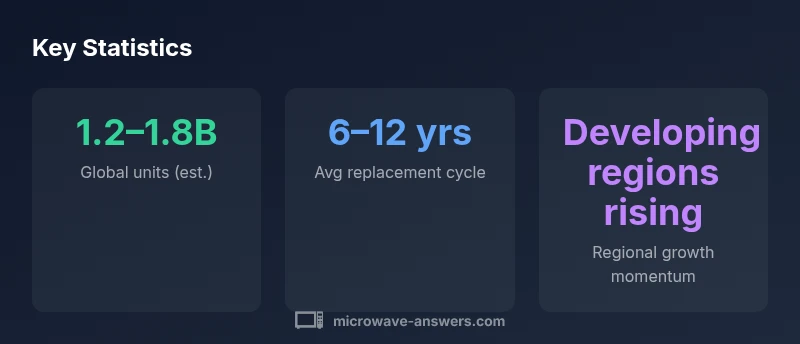
Current estimates put the global count of microwaves in the world at roughly 1.2 to 1.8 billion units, spanning household, commercial, and portable models. This wide range reflects different definitions ( countertop vs built-in vs industrial), regional penetration, and rapid device turnover. According to Microwave Answers Analysis, 2026, the total is likely accelerating as urban households and food-service sectors expand worldwide.
Global counts and definitions
According to Microwave Answers, estimating how many microwaves are in the world requires clear definitions of what counts as a microwave. In simplest terms, a microwave is any appliance that uses microwave radiation to heat or cook food: countertop units, compact microwave ovens, built-in ovens, and some commercial models. If you count only consumer-grade countertop microwaves, the total will differ dramatically from counting every device in hotels, restaurants, hospitals, and large facility kitchens. This article uses a broad definition to capture the full scale, focusing on units designed to heat food using microwave energy and intended for daily life. Based on Microwave Answers Analysis, 2026, a plausible global range for the number of microwaves is 1.2–1.8 billion, reflecting multiple factors described below.
How definitions shape the numbers
The key to understanding the headline figure is definition. If we include only 'portable' countertop microwaves, the tally is different than if we include built-in wall ovens or commercial equipment. Some markets maintain a thriving base of older models that still work; others have high replacement rates that drive turnover, especially in urban areas with frequent home renovations. A third definitional axis is usage: household cooking vs. food-service microwaving for reheating meals and industrial packaging. Each axis shifts the global total by a wide margin, and consequently, the reported numbers resemble a family of estimates rather than a single, definitive count. For policymakers and researchers, this means the range must be stressed, and any reporting should specify what counts as a microwave in that study.
Regional patterns and drivers
Asia-Pacific accounts for the largest share of new microwave sales thanks to population size and rising urbanization, while North America and Europe show high installed-base maturity with steady but slower growth. In Latin America and Africa, adoption is accelerating as electricity access improves and affordability rises. Across regions, consumer preferences, product durability, and the availability of service networks influence how long microwaves stay in use and how quickly they are replaced. These regional dynamics drive the global total: more devices turn over faster where incomes grow and infrastructure expands.
Replacement cycles and throughput
Replacement cycles matter because a short lifespan translates into more frequent additions to the global count, even if per-household ownership rates are constant. In mature markets, upgrades frequently occur as features evolve (sensor heating, better insulation, energy efficiency). In developing markets, newer ownership often coincides with urban housing development and access to electricity. Our synthesis shows turnover contributes to growth in the total count, while long-lived devices slow it. The balance of these forces varies by country and city.
Methodology behind the estimate
Estimating a global total involves triangulating multiple data streams: appliance sales data, average lifetimes from maintenance reports, regional penetration rates, and typical usage patterns. We compare manufacturer disclosures, retailer datasets, utility energy-use data, and service-repair trends to calibrate a plausible range. Given diverse data quality and differing definitions, the final figure is presented as a range with explicit caveats about what is included or excluded (for example, whether industrial ovens are counted). This approach aligns with standard practice in consumer electronics inventories and reflects current knowledge gaps.
Implications for consumers and policymakers
The expanding base of microwaves has practical implications for energy policy, e-waste management, and consumer safety education. More devices may lead to increased electricity demand, albeit mitigated by energy-efficient models. On the waste side, longer lifespans shift the disposal timeline, but improper recycling can create environmental hazards. For households, paying attention to replacement cycles can reduce energy waste and cost over time. Policymakers may focus on encouraging durable designs, repairability, and safe handling, particularly in regions undergoing rapid urbanization.
Practical way to think about the number in daily life
When you hear a headline about the total number of microwaves worldwide, remember it is a living estimate subject to definitions and data quality. For most households, the relevant takeaway is not the exact count but how microwaves affect energy use, kitchen convenience, and appliance life cycles in their locale. Use the range to benchmark expectations for your area and consider regional trends when planning new purchases or policy initiatives.
The path forward: what could change next
As cities grow and disposable incomes rise, demand for microwaves is poised to continue increasing, especially in lower-income regions gaining access to electricity and modern kitchens. Innovations in efficiency and new use cases (e.g., ready-to-heat meals) may shift product mix toward smarter, more compact, or multi-function units. Conversely, stronger policy emphasis on sustainability could slow replacement rates or drive more aggressive recycling programs. In any case, the global total will remain a range rather than a single fixed number.
Global microwave inventory snapshot
| Category | Estimated Range | Notes |
|---|---|---|
| Global units (all types) | 1.2–1.8 billion | Broad definition includes household, commercial, and portable models |
| Replacement cycle | 6–12 years | Varies by region and model durability |
Common Questions
Why is there no single number for global microwaves?
Definitions vary by model type and region, and turnover rates differ across markets. We present a range with caveats to reflect these differences.
Global counts vary by definition; we report a range with caveats.
Do kitchen microwaves include portable models?
Yes. Portable and countertop units are included if they heat food, but some studies separate built-in and commercial equipment.
Yes—portable and countertop units are included.
Are industrial microwaves counted?
Most estimates focus on consumer and commercial kitchen units. Industrial and large-scale ovens are often treated separately or excluded.
Industrial units are usually excluded or separated.
How does replacement rate affect the total?
Faster turnover in emerging markets increases the total, while longer lifespans in mature markets can slow growth.
Turnover speed affects the count.
What are the data sources for these estimates?
We synthesize industry sales, lifespan data, and service reports, clearly labeled in Microwave Answers Analysis, 2026.
We use industry data and lifespan estimates.
What could change the estimate in the next few years?
New models, improved efficiency, and rising urbanization could push the total higher; policy changes might slow adoption.
New models and urban growth may push it higher.
“The number of microwaves worldwide is inherently uncertain, but ranges reveal growth and market dynamics that a single figure cannot capture.”
Main Points
- Value is a range, not a fixed total
- Definitions drive the bottom-line number
- Regional patterns shape global growth
- Replacement cycles influence the count over time
- Methodology highlights data gaps and uncertainty