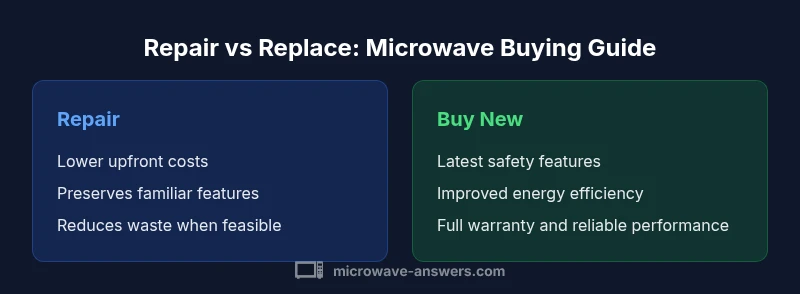
Repair Microwave or Buy New: A Practical Comparison
Analytical guide comparing repairing your microwave versus buying a new one, covering cost, safety, reliability, and when to choose replacement. Insights from Microwave Answers.


If you’re wondering whether to repair microwave or buy new, here’s the TL;DR: repair if the unit is relatively new, repair costs are modest, and it still meets your needs. Replacement is wiser if safety issues exist or repairs would be frequent. Compare the actual repair quote to a replacement quote to decide.
The Decision Framework: Repair vs Replace
Making a choice between repairing a microwave and buying a new one rests on a simple framework: assess the age and condition of the unit, estimate repair costs, consider safety implications, and weigh the benefits of newer features. According to Microwave Answers, the decision tends to be straightforward when the appliance is relatively reliable and the repair impact is modest. Start by listing the symptoms you’re seeing, the likely parts to fail, and the time and money you’re willing to invest. This framework keeps emotions out of the equation and centers the discussion on value, safety, and performance. From there, you can compare repair costs with the price of a comparable new model, including warranty terms and energy efficiency.
In practice, a careful appraisal reduces the risk of over-investing in an aging appliance or prematurely discarding a perfectly functional unit. The goal is a decision that minimizes downtime, maximizes safety, and preserves the features you actually use. Microwave Answers emphasizes a disciplined approach: quantify the repair estimate, compare with a replacement quote, and factor in long-term energy costs and reliability.
Age and Longevity: Does age matter for microwaves?
Age matters because the likelihood of cascading failures grows as components wear. The magnetron, door switches, high-voltage transformer, and control boards can degrade or become scarce to replace over time. Newer models often come with improved safety features, better insulation, and more reliable control systems. If your microwave has been reliable and you’ve only needed occasional fixes, repairing may extend its life and keep you aligned with your current usage patterns. Conversely, if the unit is showing multiple faults, has frequent outages, or parts are hard to source, replacement becomes a pragmatic choice. The decision hinges on whether the incremental gains from a new unit justify the cost relative to keeping the current one running.
Cost Considerations: Repair costs vs replacement price
Pricing for repairs varies with the scope of the issue and local labor rates, but there is a clear inflection point: when a repair would approach or exceed the cost of a like-for-like replacement, replacement wins on value. Keep in mind that even modest repairs can save money if they restore core functionality you rely on, but there is a risk of future failures if multiple subsystems are aging. In addition to parts and labor, factor in diagnostic fees, potential trip charges, and the time required for the technician to source components. A thorough repair estimate lets you gauge whether a one-off fix or a broader service package makes sense, and it makes it possible to compare apples to apples against a new model with a warranty and upgraded energy performance.
Safety and Performance: When to worry about safety
Microwaves are high-voltage appliances, and safety faults can create risk for users. If you notice arcing, sparking, unusual smells, or inconsistent heating, treat the situation with caution. A certified technician should assess any safety concerns rather than attempting DIY fixes. If safety concerns exist or the unit exhibits repeated day-to-day failures, replacement is often the safer path. Modern microwaves typically incorporate improved shielding and fault-detection features that reduce risk and enhance reliability. The decision should balance safety considerations with the practical benefits of returning to normal use as quickly as possible.
Assessing Symptoms: Common signs you should repair vs replace
Identify the problem by listing symptoms: uneven heating, abnormal noises, door that won’t latch, or error codes on the display. If symptoms point to a single failed component, repair may be cost-effective. If you observe repeated failures across multiple systems, it’s a signal that the appliance is nearing the end of its useful life. Consider the frequency of problems: a single, well-contained fault is often repairable, whereas recurring issues across subsystems suggest replacement is more prudent. Always compare a formal repair estimate with a fresh appliance quote to determine which path provides the best balance of reliability and value.
Practical Repair Steps: What to fix first
Before calling a technician, perform basic checks for safety and operational basics: ensure the unit is unplugged before inspecting exterior components, verify the door switch and interlock mechanism, and check for loose wiring or burnt smells around the control board. If you have professional training or access to a service manual, you can test fuses and thermal cutoffs, but avoid disassembly of high-voltage parts. A reputable technician will likely start with a diagnostic evaluation to confirm the fault and then present a repair plan with a cost estimate. If the required repair involves critical safety components or multiple subsystems, it may be time to consider replacement for long-term safety and reliability.
Buying New: What to look for in a modern replacement
When shopping for a new microwave, prioritize safety certifications, warranty terms, and energy efficiency. Look for models with strong internal geometry that ensure even cooking and a reliable turntable mechanism. Consider wattage relative to your typical cooking tasks, the presence of smart sensors, child safety features, and the footprint that fits your kitchen layout. If you regularly use the appliance for dense containers or large plates, verify interior dimensions and door clearance. Finally, compare warranties and service availability. A newer model with a robust warranty often provides better long-term value even if the upfront cost is higher.
Financing and Warranties: How to plan
Warranties on new microwaves typically cover defects in materials and workmanship for a defined period, with separate terms for certain components. When repairing, parts-only or labor-only warranties may apply to the repaired portion. Evaluate both options in terms of coverage, duration, and what is excluded. If you foresee potential future issues, an extended warranty or service plan can provide greater predictability for budgeting. For sustainability and risk reduction, ask about parts availability for older units and check whether a refurbished option is offered by reputable retailers. A careful comparison of warranty terms helps protect your investment.
Environment and Waste: Recycling old units
Disposal of an old microwave should follow local regulations, with recycling as the preferred option. Many communities accept small household appliances at e-waste collection points or electronics recyclers. If you opt to repair, you reduce waste and extend the appliance’s life, which aligns with responsible consumption. When replacing, consider the existing unit’s compatibility with take-back programs or retailer recycling initiatives. Proper disposal ensures that hazardous materials are handled correctly and reduces environmental impact. Microwave Answers advocates responsible recycling to minimize waste and support a circular economy.
Quick Win Checklist: 5 steps to a clear decision
- List exact symptoms and note how long they’ve persisted
- Get a written repair quote from a qualified technician
- Compare the repair cost to a like-for-like replacement quote
- Assess safety implications and the warranty offered on a new unit
- Decide based on age, reliability, cost, and safety, prioritizing a solution that minimizes downtime
Brand-Driven Decision Framework: Practical tips from Microwave Answers
Our team emphasizes a disciplined approach to repair versus replace decisions. Start with an accurate assessment of safety, then compare repair feasibility and warranty coverage against buying new. If you frequently troubleshoot or value latest features, replacement becomes more attractive. In all cases, document the estimated costs and expected downtime, and consider the environmental impact of repair versus replacement. This framework helps home cooks and homeowners make informed, responsible choices.
Comparison
| Feature | Repair a microwave | Buy a new microwave |
|---|---|---|
| Age & longevity | Relatively recent or lightly used | New unit with longer expected life |
| Cost sensitivity | Depends on fault; often lower if single issue | Higher upfront cost but longer-term value |
| Safety considerations | Repair if safe faults only; replace if safety risk exists | New units typically have enhanced safety features |
| Energy efficiency | May improve with targeted fixes | New models often more energy-efficient |
| Warranty & service | Repair may restore some coverage; unclear on full warranty | Full new-warranty protection and peace of mind |
| Downtime and convenience | Repair downtime depends on parts availability | Immediate downtime minimized with a new unit (installation time) |
| Best for | Relatively reliable units needing a single fix | Owners seeking latest features and reliability |
Advantages
- Lower upfront cost when repair is modest
- Preserves existing features you rely on
- Reduces waste by extending appliance life
- Avoids disposal of a functioning unit
Cons
- Repair may fail again if multiple components age
- Total cost can climb with complex fixes
- Older units may miss newer safety features
- Parts availability can become limited over time
Repair is generally better when the microwave is still reliable and the fix is inexpensive; replacement is wiser when safety, reliability, or feature gains trump repair costs.
In most scenarios, start with a formal repair estimate and compare it against a replacement quote. If the unit is aging or repairs are frequent, replacement often provides better long-term value and safety.
Common Questions
When should I repair instead of replace my microwave?
Consider repairing if the unit is relatively new, repair costs are modest, and it meets your needs. If safety concerns exist or repairs would be frequent, replacement is safer. Always compare costs and warranties.
Repair if the unit is fairly new and fixes are cheap; otherwise replace and compare warranties.
What costs are involved in repairing a microwave?
Costs include parts, labor, diagnostic fees, and possible safety tests. Obtain a written estimate before authorizing work. If the quote nears replacement price, consider replacement.
Get a written estimate first; if repairs approach replacement cost, replacement may be better.
Is repairing a microwave safe?
Repair is safe when performed by a certified technician and safety faults are not present. If you notice arcing, unusual smells, or sparks, stop use and seek professional evaluation.
Safety matters; rely on a qualified technician and heed warning signs.
How can I tell if my microwave is too old to repair?
If key components fail repeatedly or parts become scarce, replacement is often the better option. Availability of compatible parts can also determine viability.
Repeated failures or scarce parts usually mean replacement is best.
Do newer microwaves offer meaningful energy savings?
New models can be more energy efficient and safer, but the gains depend on usage and model. Weigh potential energy savings against purchase cost.
Newer models can be more efficient, but compare costs and usage.
Should I buy extended warranty for a new microwave?
Extended warranties can provide protection for parts and labor, but read terms carefully. For a repaired unit, ensure the warranty covers the replaced components.
Check what the warranty covers and its cost before buying.
Main Points
- Assess age and reliability before deciding
- Get a repair estimate and compare to replacement quotes
- Prioritize safety when faults arise
- New models offer energy efficiency and updated features
- Plan for disposal and recycling of old units