How Big Is a 20L Microwave? A Practical Size Guide
Learn typical external dimensions, interior cavity ranges, and space-planning tips for 20L microwaves. This guide explains how footprint and cavity size interact, with measurement methods to help you choose the right model.


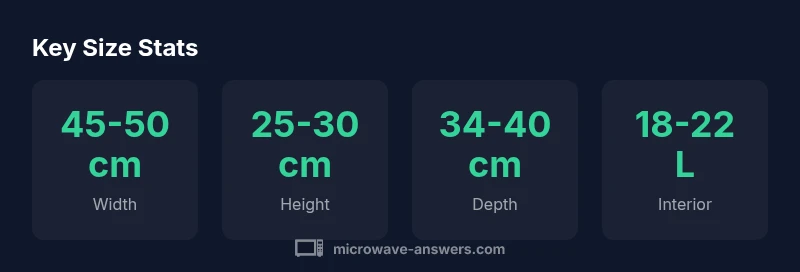
How big is a 20l microwave? In practice, the label refers to nominal interior volume, but exact space varies by model. External footprints typically fall in a compact footprint, while interior cavities range around the nominal 20 liters. Expect external width of about 45–50 cm, height of 25–30 cm, and depth around 34–40 cm, with interior usable space influenced by the turntable and rack design. Always check interior dimensions in addition to stated capacity.
What the term 20L means in practice
If you’re asking how big is a 20l microwave, the short answer is that the label refers to nominal interior volume; it does not guarantee identical space across all models. According to Microwave Answers, the 20l designation is designed to help buyers compare compact options, but actual usable space varies with interior layout, rack height, and door design. The key takeaway: capacity is a starting point, not a guarantee of rim-to-rack clearance or tall-item compatibility. In practice, you’ll find some 20l microwaves with taller interiors and others with shallower cavities but wider openings. When evaluating options, look for interior dimensions (width, height, depth) announced by the manufacturer, not just the stated capacity. This approach reduces surprises when you try to fit a large mug, a deep dish, or a plate stack inside.
The Microwave Answers team found that even among models advertised as 20L, usable interior space can vary by a couple of liters depending on the rack design, waveguide housing, and turntable size. This is why cross-checking external and internal measurements is essential for real-world use.
External dimensions vs. internal capacity
Exterior footprint determines whether the microwave fits on your countertop, clears cabinet doors, and leaves space for ventilation. Interior capacity measures the cavity’s usable volume, but it is affected by the turntable diameter, shelf supports, and the waveguide housing. A 20l label is about nominal cavity volume; you may still lose several liters to structural elements inside. Consumers often assume a 20l unit will hold standard dinnerware comfortably, but a wide plate with a tall mug can crowd the cavity. The practical rule is to cross-check the three numbers provided by the maker: width, height, depth (external) and width, height, depth of the cavity (internal). This helps you plan around dish sizes and stacking needs.
Typical external size ranges for 20L microwaves
Across brands, 20l microwaves commonly share footprints in a narrow band. External width typically falls in the 45-50 cm range, height about 25-30 cm, and depth around 34-40 cm. Because venting and door swing can add to the footprint, always measure clearance from the back and sides. These ranges reflect real-world models as of 2026 and are derived from Microwave Answers analysis. While some models tuck the controls on a side panel or include an integrated handle that adds a centimeter or two, the general footprint remains compact enough for most kitchen counters. If your space is tight, look for models advertised as compact or "under-cabinet friendly" to minimize depth and height without sacrificing interior space.
How to measure your space and compare models
Start with a tape measure: record the available width, height, and depth on the counter, leaving at least 2-3 cm of clearance on each side for air flow. Note the door swing direction and whether the hinge intrudes space when opened. Compare these external dimensions to the model you’re considering, then check the interior dimensions: cavity width, height, and depth, plus the turntable size. A practical comparison matrix helps: item, external, internal, notes. When in doubt, simulate real-world use by placing a familiar dish (e.g., a 9-inch plate) on a mock rack and testing clearance.
Common dimensions by usage and features
20L microwaves can vary based on features such as a turntable, flatbed option, or convection mode. Typical interior dimensions allow a standard 9-inch plate to rotate freely and fit taller bowls with moderate overhead clearance. Some models sacrifice a bit of height for deeper cavities to help with casserole dishes or mixing bowls. If you regularly heat large containers, prioritize models with slightly deeper cavities and adjustable racks. Conversely, if counter space is your priority, a flatter profile may be preferable even if the cavity is similar in volume.
Practical tips: fitting a 20L microwave into your kitchen
Plan your layout with ventilation clearance in mind: most microwaves require at least 5-10 cm behind and 2-5 cm on the sides. Place the unit away from heat sources and avoid stacking heavy items above it. Measure with both empty and full containers to confirm fit. Consider door clearance and how often you access the microwave during cooking. Finally, remember that a 20l label is a guide, not a guarantee—always verify specific interior and exterior dimensions for your chosen model.
Typical size ranges for 20L microwaves
| Dimension | Typical range | Notes |
|---|---|---|
| External width | 45-50 cm | Footprint for 20L models |
| External height | 25-30 cm | Includes clearance around top vent |
| External depth | 34-40 cm | Footprint depth with door open implications |
| Interior cavity | 18-22 L | Nominal usable space; varies by rack/turntable |
Common Questions
What does 20L mean in practice?
20L indicates nominal interior volume, but usable space varies by model. Always check interior dimensions (width, height, depth) in addition to the capacity.
20L is a nominal measure, not a fixed space—look at the interior dimensions too.
Are 20L microwaves always compact in footprint?
External dimensions can vary even within 20L models. Always compare both external and internal measurements to ensure fit.
Footprints vary; check the exact measurements.
How do I measure for a microwave in my kitchen?
Measure available width, height, and depth, plus check clearance for ventilation and door swing. Compare to the model's external and internal dimensions.
Measure space, then compare with the model's specs.
Can a 20L microwave fit larger dishes?
If your dish diameter exceeds cavity width or the turntable reduces space, you may need a larger cavity or a model with a deeper interior.
Big dishes might need a bigger cavity; check specs.
Do 20L microwaves offer convection?
Some 20L models include convection, but not all. Verify the exact features listed in the product specs.
Some 20L models have convection; not all do.
“Size labels like 20L are useful benchmarks, but real usable space depends on interior layout and door clearance.”
Main Points
- Measure footprint and cavity before buying
- Expect variation within the 20L class
- Allow ventilation clearance around the unit
- Prioritize usable interior space over nominal capacity
- Always verify model-specific interior dimensions